Showing posts with label organic. Show all posts

Wednesday, November 21, 2012

Soy Milk

Gadgets can fill a kitchen. We prefer items that do not require electricity, but some of our most used appliances are electric. We recently purchased a soy milk maker, and we like it a lot.

You take 3/4 cup of dry soy beans, soak them, and then put the soft beans into the soy milk maker, and about 15 mins later, you have soy milk. You pour the milk through a strainer to collect the solids, and then add 2 T sugar, 1/4 t salt and 1/8 t vanilla. That is it! We like the result, and likely this method is costing pennies on the dollar compared to purchasing soy milk from the grocery. We have made tofu from the milk as well.

The reason for this post is not an infomercial for a soy milk maker, but to explain something that will help in eating soybeans in any form. We have found a dramatic taste improvement if we sort beans, and use only whole, intact beans. After sorting them, we prepare boiling water in a pressure cooker. We add the dry beans to the boiling water, and immediately bring them up to 15 pounds pressure. We let them cook for 15 minutes, and then set them aside to slowly cool. The result of this effort is a product that has markedly less "bean-y" flavor.

I suspect that there is an enzyme related to oxidation that causes the "bean-y" flavor. By keeping exposure to oxygen limited (whole beans), and cooking with high heat destroys the enzyme involved in oxidizing a substance in the bean. By following these two steps, we find the end product of the soy milk is much improved, and perhaps even comparable to store-purchased soy milk.

I suggest you get non-GMO (organic) soy beans for your soy milk and tofu production.

Monday, July 16, 2012

Fruit Tree Pests

I have been told that one of the hardest areas in farming organically is fruit trees. Pests love fruit trees, and especially the developing and mature fruit. Insects and animals can pose serious challenges. Let's explore these, and suggested treatments.


Insects

A relative has in the past had extensive damage from several insects in his orchard. He has developed some creative solutions. He uses an electric zapper with two types of light source (florescent and incandescent.) Below the zapper he places a small wading pool of water, and wets the water with a detergent. In his experience, many moths and insects will be attracted and stunned, but not be killed. When stunned, the insect will fall to the ground, and with the wading pool below the moth kill is dramatically increased. Helpful insects are not strongly attracted to the zapper, while moths are strongly attracted. Moth pupae are damaging to many crops on the homestead. One person told me they could not think of a beneficial moth-- all are destructive to something. They love to fly at night, and if you have electricity, you can zap / drown a lot of them.

Another promising control measure is a clay product called Surround. It coats the tree and fruit in such a way as to confuse insects and camouflage the fruit which limits infestations. This product can be washed off with rain, and has to be applied weekly.


Peach Tree Borer

Traps can indicate the presence of adult moths, and once present, you will soon have eggs on the lower part of your peach trees. The eggs hatch in 7 days, and the larvae descend to ground level and burrow into the bark. Control measures applied to the tree need to be precisely timed to catch the eggs or larva before penetration below the bark.

Some farmers are convinced that the bug zapper has eliminated the peach tree borer damage. This moth is active in the day, but I have read reports that they mate at night, and therefore would be susceptible to the bug zapper.


Plum Curculio

This small snout beetle, 1/4 inch long, dark brown in color with patches of white or gray, lays its eggs on developing fruit, and the larva will burrow in and often destroy the fruit. Home gardeners can help reduce future problems from the Curculio by picking up the damaged apples as they fall off the tree and destroying them before the adults emerge. In apples, the larvae will only complete development in fruit drops.

Animals

Birds can quickly ruin a crop of mature fruit. I have a friend who watched a bird go from peach to peach throughout an entire tree taking one gouging bite from each nearly mature peach. The bird was doing great damage, and not eating hardly any of the fruit to become satiated. In a short time, such damage will rot and spoil the entire peach. Netting the entire tree is suggested if you have this type of damage. It is almost impossible to keep the birds out otherwise. Select a netting size that will not entangle the birds that land on the netting.

Strings draped through the tree foliage has been reported to discourage crows from staying in the tree.

I have seen electric wire around the trunks of fruit trees to discourage squirrels and similar from climbing the trunk to destroy fruit.

Monday, May 21, 2012

Lettuce

Lettuce plants grow in cool weather, and with a little protection may overwinter. Most dark greens are good sources of Vitamin C and other nutrients. The rule of thumb is, usually, the darker the greens, the more nutritious the leaf.

For a market garden, you will get more income for leaf and lettuce crops per square foot of garden space.


Planting

Early spring is a great time to plant your lettuce seeds. Lettuce likes the cooler temps, generally 40 to 60 degrees F. In warmer climates, you can likely grow lettuce until it reaches about 80 degrees F. If you plant seeds in the spring, you should try to get started at least a month before the hot weather hits your area. You can also plant in the late summer for a fall harvest.

Something new that we are trying this year is the planting of lettuce in a shaded garden under a part of our forest canopy. The trees are large, and tree trunks are spread far apart. This area that is significantly cooler than our open field gardens in the heat of the day. A friend has reported good success with this type of forest planting. We will see how it goes for us this year! (UPDATE, this did not work for us in 2012. I think you have to get the plants started in the early spring. There just was not enough light in this plot to get the lettuce going.)

We make a shallow furrow, and sprinkle in the seeds. Then we cover with the slightest dusting of potting soil to help hold moisture. Some seeds need light to germinate, so don't bury those kind of seeds.

You should see seedlings sprouting in 7 to 10 days. When your lettuce is about 1 to 2 inches high, you should thin the plants a bit so that there is about eight inches of space between each other. If you want to have lettuce growing throughout the season, you can plant different types every few weeks (about 10 to 14 days apart). This is called successive planting. (web)


Planting Record 2012

This late winter, we noticed some small lettuce volunteer plants coming up from the Black Seed Simpson leaf lettuce patch. Last year we allowed the patch to go to seed, and new plants were growing even though there was snow outside. When we could work the soil, we transplanted these into a lettuce bed, and they filled the bed of 4' by 60'. We have been eating this lettuce all spring, and it is just now starting to rise up getting ready to bolt. For the past week or so, we have noticed this lettuce becoming a bit bitter as our temperatures have been rising.

From this experience, we can see that lettuce can really grow early in the season!

On May 21 we planted 5 rows in the woods consisting of:
  1. Lettuce Sangria MTO
  2. Lettuce Beleah Rose
  3. Lettuce Cimmaron
  4. Romaine Lettuce Red Amish Deer Tongue
  5. Romaine Lettuce Parris Island

As of June 10, we can conclude that we waited too long to plant in the woods, or that our woods are too dark. There are some small weeds growing, but the lettuce planted does not seem to be doing well.


Pests

Lettuce can be attacked by a variety of insects and animals. I have seen small lettuce plants in a green house covered by aphids. Insecticidal soap can be effective deterrent for aphids.

Rabbits and deer could also be attracted to your offering of salad. Fencing is suggested if animal pressure is high.


Harvest

We suggest you harvest in the early part of the day. I think lettuce plants are crisper and a bit sweeter in the early morning as compared to afternoon harvests. Cool lettuce quickly and store them in a cool location. The crop should be cleaned, and then dried to prevent spoilage.


Resources
  • Pests of Lettuce (web)

Tuesday, March 13, 2012

Blueberries

Blueberries have gotten some good press about their health giving properties. As perennials, small fruits and berries will perform year after year without the startup work required for vegetables. Since we live in the north, blueberry fields are common in our area, and we have grown to love them.

Our plan is to plant 10-20 blue berry plants this spring. The biggest challenge we face is that our soils are alkaline, and as noted below, these plants love acidic soils. This will be a major challenge to change the soil pH around this growing area.


Growing preferences

Blueberries come from bushy plants that love boggy and wet areas. They do not want to be covered with water, but they do like to keep their roots moist. We have a wet area along the side of our field that we think would be ideal for our new blue berry plants.

They also like acidic soil, as is found in a bog. Your target pH is 4.5 to 5.5, and most soil will need amendments to assist in the lowering of the pH. Amend the soil to a depth of 14 inches by two feet wide. Pine needles, pine bark, elemental sulfur, ammomium sulfate and peat moss can lower the pH in your garden bed that will hold your blue berries. Canadian sphagnum peat moss has a pH of 3.0 to 4.5 making it an ideal amendment for blueberries. If necessary lower pH and supply nitrogen by adding 1 lb. of ammonium sulfate commercial fertilizer to 100 feet per inch depth of sawdust. Organic growers can use elemental sulfur and cottonseed meal or feather meal. It takes several months to a year for sulfur to lower the pH. Prepare blueberry planting site well in advance for best results.


Varieties

Follow this link for a beautiful chart of blueberry varieties. (web)

Elliott has one of the highest levels of antioxidants of all blueberry varieties.
     Once picked Elliott has a storage life of up to 12 weeks. (web)


Varieties we have planted in 2012, and updated in 2014 replacing a dead Bluecrop.

Duke         x1
Bluecrop    x9
Blue Ray    x10
Earliblue    x10
Ka-Bluey    x5
Chandler    x5


Planting and soil preparation

"Select a sunny location with well-drained soil that is free of weeds and is well-worked.  It's best to locate your blueberry plants in an area where irrigation is readily available as best results will be achieved by keeping the root zone moist throughout the growing season.

"Blueberries prefer acidic soils. A fail-safe way to grow blueberries in almost any soil is to incorporate peat moss into the planting medium. For planting directly in the ground, work up a planting area approximately 2½ feet in diameter and 2 foot deep for each plant. Remove 1/3 to 1/2 of the soil. Add an equal amount of pre-moistened peat moss and mix well.  (One 4 cubic foot compressed bale will usually be sufficient for 2-4 plants.)" (web)

Space your bushes from 4 to 6 feet apart with 7 to 10 feet between rows. Commercial farms space the rows 10 feet apart which is large enough for tractor access down the row. The home gardener can plant them 3 to 4 feet apart in any arrangement fitting the home landscape. Set at the same depth plants grew in container or ground. Planting too deeply will smother the roots. Little or no pruning is needed for the first two years except to remove broken or rubbing branches. Strip off all blossoms and fruits until the plant is well established (36 to 42 inches tall).


Mulch

Blueberries require mulch. For the first year mulch with fir, pine, or hemlock well rotted sawdust extending out 2 feet around plant to a depth of 3 inches so roots will not grow up into the mulch. After the first year increase mulch to a depth of 6 inches mounded around the crown. As plants mature extend the mulch out to the drip line. Mulch will gradually break down to help feed the plant and supply the high rate of organic matter blueberries need. More important, mulch provides a cool root run and conserves moisture, both requirements for blueberries. Other materials may be used as mulch such as composted pine needles or shredded leaves. General compost made from vegetable materials may be too high in pH for blueberries. Fresh grass clippings can heat up and damage surface roots. (web)


Planting History 2012

We ordered one Ka-Bluey plant online via a sale, and 4 more from another online site. The 30 other plants were picked up at a wholesaler, at a much better per unit price. The single Ka-Bluey came in the mail a week before we had scheduled to get the other plants from the wholesaler, so we put it in the ground on April 2. We were gone to a retreat for the next week, and there were some cold nights while we were gone. We watered well, and a friend also watered the plant, but when we returned, the once green leaves were brown red. I thought it was dying. Looking this up on the Internet, I see this is common for plants that were used to the warm, being transplanted into the cold of early spring to have the leaves turn red. This is the normal coinsurance in the fall due to cold temps. I hope the plant pulls through. Since we have been back to the homestead, I have protected the plant by covering it with an overturned bucket on the nights of frost danger.

10 Bluecrop ready for planting
We have waited to plant any additional plants till the 10 day forecast does not include the chance of frost. Hopefully we will plant the rest of the blueberry plants this Friday, April 13. Since our soil is alkaline, I wanted to dig a large hole and amend the soil with ag sulfur deeply. With the backhoe, I dug a trench 2 feet wide and about 3 feet deep. I will mix peat, ag sulfur, and compost and return the soil to the trench, and then will plant the blueberries with a generous amount of peat around its roots (say 2 shovels full).

We are planting the blueberries in 2 rows of 20 plants. We are setting our plants 4 feet apart within the row, and the rows 7 feet apart. We are not planning to need to drive the tractor down the row, and can therefore save the space, and have the rows closer together.


Pruning

"One of the biggest mistakes home gardeners make with their blueberries is lack of pruning. Aggressive, annual pruning will result in healthier, more vigorous plants and more prolific fruit production. Here are some simple tips:
  • Pruning is best done in the spring before the leaves come out.
  • Remove low growth around the base.
  • Remove the dead wood, leaving bright colored lateral branches. Cut out any short, discolored branches.
  • Continue pruning until you have removed 1/3 to 1/2 of the wood out your plants each year. Remember, this will promote growth and berry production so prune away!" (web)

Propagation

When you prune your blueberry plants, remember to save your clippings to start new plants. Clip the root end of the swig at an angle, and the top cut flat. Dip the angle cut end in rooting hormone, and plant in growth medium, and keep the atmosphere moist.

When roots have developed, plant in a location where you can protect it through the first winter. Some suggest building a mimi-greenhouse of plastic, straw and more plastic. This would sandwich the straw between the plastic to keep the straw warm, and preserve the thermal blanket effect.


Resources

Monday, February 13, 2012

Micro Greens & Sprouts

Microgreens are tiny leafed vegetables. Microgreens are just baby vegetable plants, used as greens. They are beyond sprouts stage, and are harvested when less than two inches tall. Some call them "vegetable confetti."

Commonly grown varieties of microgreens include: Amaranth, Arugula, Beets, Basil, Cabbage, Celery, Chard, Chervil, Cilantro, Cress, Fennel, Kale, Mustard, Parsley, Radish, and Sorrel. Several varieties can be mixed together to create combinations of tastes, textures and colors. The crops used for microgreens usually do not include lettuces because they are too delicate and wilt easily. Both baby greens and microgreens lack any legal definition. The terms "baby greens" and "microgreens" are marketing terms used to describe their respective categories.


Health Claims

There are many Internet sites that claim superior nutritional benefit from eating microgreens. As outlined in an article, Fresh Origins points out that most of these have not been backed up by scientific nutritional analysis. We need to be cautious about calling microgreens the next "wonder" food.


Why?

So why the interest in microgreens? For one the flavors of these small plants are almost explosive. You can enjoy a dazzling array of new flavors. Plants are at their absolute peak of flavor intensity at the microgreens stage of life.
The greens are easy to grow indoors, in a greenhouse or in a garden. Some refer to microgreens as the perfect counter-top gardening.

Chefs favor microgreens as a garnish, but these plants are versatile enough to be used as a sandwich topper, salad, in a soup or as a centerpiece to a main dish.


Growing Microgreens

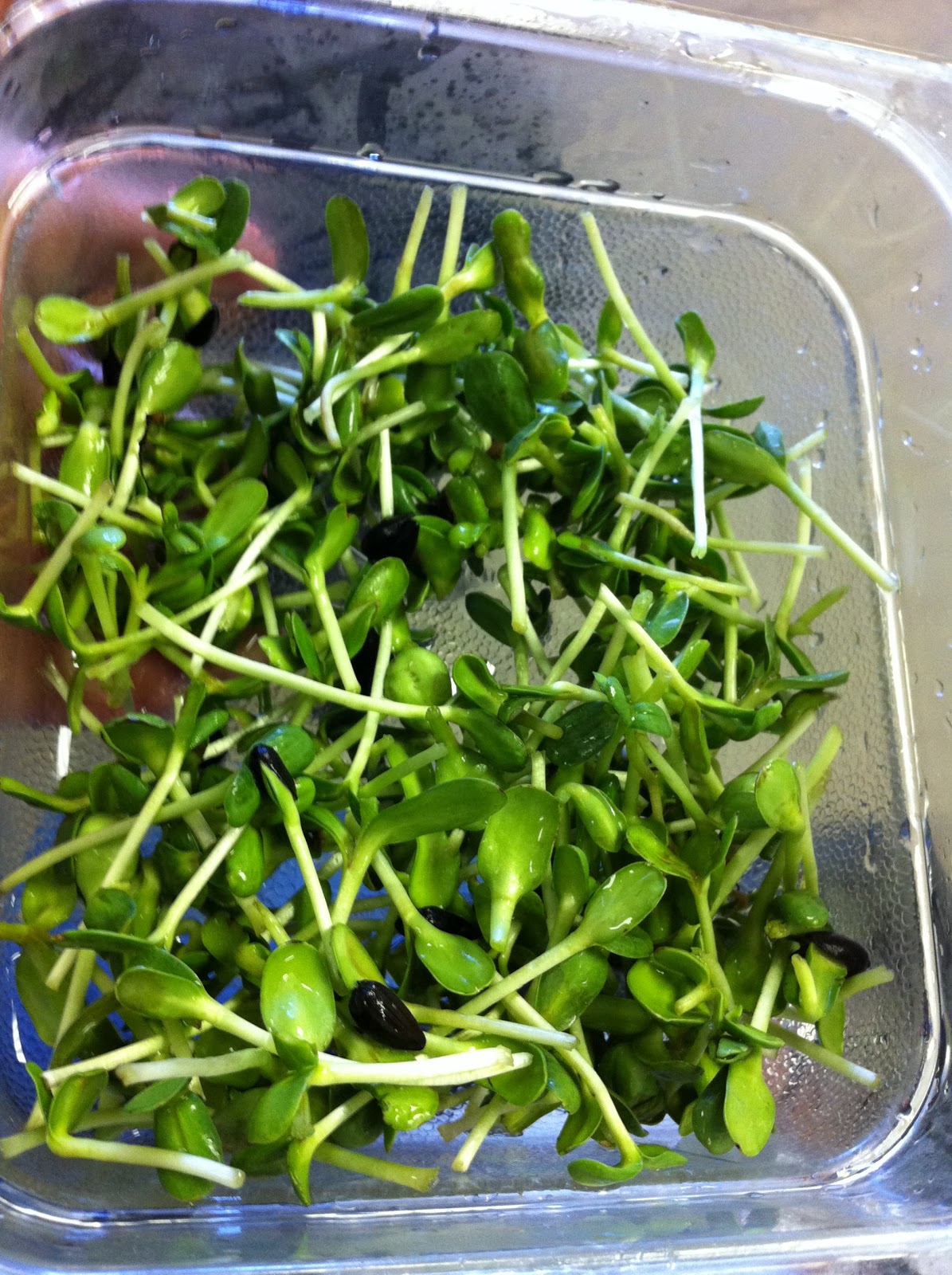
Often microgreens are grown in trays with the seeds being dense enough to fill the tray with greens (as in the first image in this post). Many plants will grow fine with a mesh or fiber bedding and water. You can place around 2 cups of slightly acidic water in a tray with your seeds. Keep them in the dark for several days, and then expose them to light to green up for harvest.. A few plants do best with actual soil, such as sunflower, buckwheat, pea, cilantro and beet.

Various crops will be ready for microgreen harvest from 10 days to several weeks. You can experiment with the size of greens you prefer, and harvest as you desire. Since the plants will continue to grow, you have a range of sizes to choose from.

Sunflower, buckwheat, beet and pea all need to be pre-soaked in cold water.  Each should be soaked for 6 to 8 hours, except for beet seeds which should only be pre-soaked for an hour or two.

Amaranth, Bok Choi, and arugula do not like full sun. They do best with indirect light.


Sprouts

Sprouts are germinated seeds and are typically consumed as an entire plant (root, seed, and shoot), depending on the species. For example, sprouts from almond, pumpkin, and peanut reportedly have a preferred flavor when harvested prior to root development. Sprouts are legally defined, and have additional regulations concerning their production and marketing due to their relatively high risk of microbial contamination compared to other greens. Growers interested in producing sprouts for sale need to be aware of the risks and precautions, and oversight required by the FDA.


Resources

Wednesday, February 1, 2012

Food Safety

We all know that food safety is important. Eating contaminated food brings very upsetting gastric results. All of us likely have had at some time the unpleasant effects of food poisoning. Some forms of contamination can lead to death.

When I was young (a long time ago :), the concern I heard was about leaving meat and dairy out of the refrigerator, where it could culture harmful bacteria. These days we hear of massive food recalls, of both meat products and vegetables. What has changed that fruits and vegetables are now killing people like meat has for ages?

Recently there was a massive recall on lettuce and cantaloupe. Food that I have not considered at risk for e-coli contamination before. Thousands of tons of food has been destroyed in large multi-state food recalls. How is it possible that people in 18 states were made sick, 72 ill, 13 deaths, and that the contamination was linked to one farm? (web) The answer rests in how food is processed and packaged. We have monopolized and consolidated the food industry to a point that only a few companies control the entire food system. This is even of real food such as cantaloupes! (See my article on edible food like substances.)

It is really unfortunate that any food is contaminated, but it is worse to have this one contamination have such a large reach across the country! When I was a child, food was processed for a more local distribution area. Today, large companies will compete offering the lowest prices to grocery outlets. The way they obtain efficiency is in consolidating the packing processes to one large facility. They truck the food into and out of that facility. If contamination begins, it now has access to spread to a very large geographical distribution area. In this way, costs are lowered, but food safety risks are increased. Having to move food around like this is part of the reason we spend 10 calories of petroleum for every calorie of food. (Commercial fertilizers and pesticides made from petroleum, and fuel to power the massive equipment also consume petroleum.)

The corporate multi-national food industry responds to contamination issues as a mechanical problem. They gather their engineers together and come up with a bacteria control solution. Perhaps they can douse the food with stronger chemicals to kill the bacteria. Perhaps they can heat it so hot the threat is killed, no matter what happens to food quality. (After all if it does not look fresh, just add some artificial coloring chemicals.) It is a vicious cycle of adding chemicals to fix a broken system, and no one is looking at the root cause of the problem. It was the consolidation and mechanization that created the potential for cross contamination in the first place.

I do not believe that the solution to food safety is government regulation. This is not a problem the government will be able to correctly fix, because they are not looking at the root issues of what is wrong. Any response that does not bring food back to local responsibility is doomed to put more band-aids on a festering wound.

Eating locally grown food just makes so much sense! You eliminate the massive waste in transportation. You reduce the potential of cross contamination. You support your local economy, not the international corporate conglomerates bottom line. You know who grew your food. You know that no poisons were lathered upon what you will eat. You know it is safe to eat. The ultimate in eating locally, is to grow your food yourself.


On the farm

Perhaps we should turn our attention to more practical matters: how do we assure food safety on our own farms? Below are some ideas I would like to suggest:
  1. Keep animal products separate from vegetable prep areas. I would suggest dedicated cutting boards for each, and don't mix the two.
  2. Clean and disinfect sinks between uses, especially if preparing animal products.
  3. If canning, pressure cook low acid vegetables per USDA canning time and pressure recommendations.
  4. Keep produce as cool as possible, to the ideal temps per the food item.
  5. Wash hands often and for an adequate duration.
  6. Clean and sterilize lugs and storage bins between uses.

How safe is your food? Eat local.

Monday, January 23, 2012

Is Organic Better?

I am going to make a guess that most people interested in this blog would agree that organic foods are better for you, and I fully believe this. I want to review the basis for locally grown, organic foods, and review the facts that we can substantiate of why organic foods are truly better for you. Note it is not as simple as we may at first think. As we start this article, think for a moment about how you define food quality.


So how really do you measure food quality? It is not an easy question to answer. We do have some principles we can use to help qualify the quality of our food.

Quality indicators of food:
  • Food should be free from decay.
  • Food should be completely ripe when picked. Foods may appear to ripen if picked early, but vitamin and nutrient values will never attain the levels possible if the food was allowed to vine ripen.
  • Food picked from your own garden is the ultimate in freshness and ripeness.
  • Once food is picked, some nutrients such as vitamins start to decline. Commercially processed food sits 5-14 days in transit before you could purchase it in the market.
  • You need some raw foods in your diet. Cooking destroys 35% of the isothiocyanates you would have gleaned from the raw food. You need cooked greens also to get the volume of nutrients you need. (Juicing greens is a way some have increased volume intake of raw greens.)
  • Growing food yourself allows you to select vegetable varieties with more flavor and nutritional content. Commercial growers primarily select varieties that withstand weeks of shipping.
  • Phytochemicals are lost in long term storage and/or preserving. These nutrients would best be gained in immediate consumption of fresh raw foods.
  • Having mineralized, fully ripe foods before consumption or preservation is perhaps more important than the specific method of preservation of the food. One study concludes that fresh, frozen or canned foods have comparable vitamin and nutrient content.
  • Water soluble vitamins can be leached from the foods if boiled. Steaming is preferred. Save and ingest any residual water from the cooking process.
  • Some hold brix levels as a good food quality indicator, but I suggest caution. The sugar content is a concentration value of sugar in water, so the hydration of the plant has a drastic effect on the brix reading. In one anecdotal experiment: carrots which were forgotten in a large walk in cooler, were found wilted and shriveled. These were were tested and showed higher brix reading than fresh organic carrots picked directly from a nutrient dense growing plot. The taste and quality comparison did not align with the brix reading.

Joel Fuhrman MD suggests there are 4 categories of high nutrient foods. We need to think of our diets being composed of a mix of all of these categories.
  1. raw vegetables              - snow peas, cucumbers, tomatoes
  2. fresh fruits                     - apples, grapefruit, berries, melons
  3. cooked greens               - string beans, cabbage, asparagus
  4. non-green vegatables     - eggplant, peppers, tomatoes, mushrooms

Joel Fuhrman MD has also made a listing of foods by nutrient density on a comparative scale of 1000 (nutirients / calories). He suggests we ingest a significant volume of our calories from foods that have a nutrient score higher than 100.
  1. Kale                         1000
  2. Collards                      916
  3. Spinach                       886
  4. Bok Choy                   839
  5. Romaine                     462
  6. Boston                        412
  7. Broccoli                     395
  8. Artichoke                   352
  9. Cabbage                    344
  10. Green Pep                  310
  11. Carrots                       288
  12. Asparagus                  280
  13. Strawberry                 254
  14. Cauliflower                 269
  15. Tomato                       197
  16. Cherries                      197
  17. Blueberries                  155
  18. Iceburg                        132
  19. Orange                        130
  20. Cantaloupe                  120
  21. Apple                            91
  22. Peach                            88
  23. Kidney Beans                84
  24. Green Peas                    84
  25. Sweet Potato                 81
  26. Soybeans                      74
  27. Tofu                              69
  28. Mango                          61
  29. Cucumber                     59
  30. Oatmeal                        55
  31. White Potato                 53
  32. Brown Rice                  49
  33. Salmon                         48
  34. Skim Milk                     43
  35. Grapes                          40
  36. Corn                             37
  37. Avocado                       36
  38. Banana                          36
  39. Walnuts                         35
  40. Almonds                        33
  41. Chicken Breast              32
  42. Low Fat Yogurt             31
  43. Apple Juice                    30
  44. Eggs                              29
  45. Feta Cheese                   25
  46. Whole Wheat Bread      25
  47. Whole Milk                    23
  48. White Pasta                    22
  49. White Bread                   21
  50. Peanut Butter                  21
  51. Swiss Cheese                 18
  52. Ground Beef                   17
  53. Potato Chips                   13
  54. Vanilla Ice Cream            6
  55. Olive Oil                          2
  56. Cola Drink                      0.6

So, we see that we need a variety of foods, and to focus on foods that are nutrient dense. This excludes processed foods and animal products as a valuable part of our diet. Research is clear that ingestion of animal proteins increases disease risk.

An interesting article in the NY Times, by Mark Bittman, suggests that for most Americans, this entire question of organic food quality is a mute point.
"The truth is that most Americans eat so badly -- we get 7 percent of our calories from soft drinks, more than we do from vegetables; the top food group by caloric intake is “sweets”; and one-third of nation’s adults are now obese -- that the organic question is a secondary one. It’s not unimportant, but it’s not the primary issue in the way Americans eat." (web)

Some foods from conventional farming are laced with more pesticides than other types of food. If you wanted to limit your pesticide intake, the following foods would be good to get as organic:
  1. apples
  2. celery
  3. strawberries
  4. peaches
  5. spinach
  6. nectarines - imported
  7. grapes - imported
  8. sweet bell pepers
  9. potatoes
  10. blueberries - domestic
  11. lettuce
  12. kale / collard greens

So how much of your diet is made up of real food, vs edible food like substances? How important is eating organic to you?  I would raise an even higher bar: How much of your own food do you grow? Let's talk about it.


Resources:


Following is a list of assumptions and/or assertions I would like to evaluate in a future article(s). If you have information to back up or disprove any of these assertions, I would be interested in dialog with you.
  1. Soils are being depleted by modern commercial farming practices, and therefore foods grown on these depleted soils are not as nutritious.
  2. Commercial food processing often adds salt and fat calories at the expense of minerals and vitamins.
  3. Organic foods are free of pesticide residues, while conventionally grown food, especially food from other countries, carry significant pesticide residues.
  4. Pesticides in and on our food has adverse effects when consumed.
  5. Organic farming processes present compelling advantages over conventional farming in environmental,  ecology, and soil biotic composition.
  6. GMO organisms have been touted as the tools to feed the world, but they are actually a smoke screen for a very small number of companies to control the food production of the world.
  7. GMO seeds to not increase yields. They only facilitate large mono culture crops.
  8. Conventional farming techniques damage the soil and render it lifeless and susceptible to erosion.
  9. High brix (sugar content) is a significant food quality indicator.
  10. Healthy plants resist pest attack.

Sunday, January 22, 2012

Common Sense Nutrition Rules

In my study of nutrition and food, I have come face to face with a startling fact. Americans eat very poorly. In an article I will post tomorrow explaining the value of organic foods, I have come to the realization that organic is not the prime issue of concern in the American diet. Our young people are getting far more calories from soft drinks than from all their combined vegetable consumption (web). To argue that the few vegetables that they eat be organic is missing the point of eating healthfully.

So what are we eating rather than food? What is an edible food like substance? The classic example is the Twinkie. It can sit on the shelf and not rot or mold and hold its texture for years. It seems the fungi and bacteria have better sense as to what is good food than most Americans!


So here are some simple diet rules:
  1. Eat food, not too much, mostly plants.
  2. Don't eat anything your great grandmother wouldn't recognize as food.
  3. Don’t eat anything with more than five ingredients, or ingredients you can't pronounce.
  4. Stay out of the middle of the supermarket; shop on the perimeter of the store. Real food tends to be on the outer edge of the store near the loading docks, where it can be replaced with fresh foods when it goes bad.
  5. Don't eat anything that won't eventually rot. "There are exceptions -- honey -- but as a rule, things like Twinkies that never go bad aren't food," Pollan says.
  6. Always leave the table a little hungry.
  7. Enjoy meals with the people you love.
  8. Don't buy food where you buy your gasoline. (rule 1-8 from web)
  9. Don't purchase a cereal that will color the milk. (video)
  10. The whiter the bread, the sooner you'l be dead. (video)
  11. Cook for yourself, it's going to be healthier than what you're buying. (web and video)
  12. Don't buy a food that is advertised on TV. (video)
  13. Wash hands and food with running water.
  14. Don't eat foods that once had a face. 

Do you have a favorite rule that helps your family eat healthfully?


Resources:

Tuesday, December 27, 2011

Land

Land is the foundation of farming. Is is the capacity to feed yourself via crops. Land grows the wood lot which offers wood to heat your home, water and food. Land provides an environment of growth and development for your family. Farmers, gardeners, yes all of us love our land. As I have grown older, and perhaps wiser, and I have moved around the country several times, I realize that the land we own is truly just ours for a short time. We are stewards of the land we own. If time will last, our land will surely outlast us.

My interest in land has grown as I have wanted to enlarge our family garden enterprise. Without tillable land, we can have interest but may be limited in our production potential.

How much land can you work effectively can be calculated by the number of people working the soil, the type of crops, your environment and soil type, how intensively you will grow crops, and what machinery will assist you in the farming process. One farmer friend in West Virginia estimates that one person can handle from one to two acres of vegetable garden without mechanical equipment. Techniques can be employed to improve efficiency, and over a period of years, weed pressure is decreased.

For those looking for land, the key criteria are: 1) room for crops in tillable land and room for nutrient fields of cover crops and crop rotation, 2) wood lot with enough trees to sustain your wood heating needs, 3) available water.


As I have looked for land, I have added these criteria (from a list made in 2010):
  • 20+ acres
  • Water available
  • Land suitable for food production
  • Wood lot suitable for heating and cooking
  • Remote, with lower immediate population pressure, but have outreach potentials
  • South facing land for crops, north facing for fruit trees
  • Opportunities for nature / hiking / camping in the greater community
  • Some elevation change would be preferred for a basement walkout, root seller, and water gravity flow
  • All acquisitions be dept free
  • Scenic vistas would be enjoyed

I do not know what to suggest for the quantity of these three root criteria. A large part of the equation is how many people you will be having work in your enterprise. For an independent family farm, by current guess at a minimum would be 20 acres. A promise from inspiration: "God can bless twenty acres of land and make them as productive as one hundred..." 5T 151.3 The context of this quote is that we need to guard against amassing or hording land in greed. Other references balance this with the encouragement for schools and sanitariums to obtain as much land as possible as a buffer around the institution. Some of these recommendations specify into the hundreds of acres.

One thing is clear, we do not want to make our land our idol. We should ever be ready to heed God's call or public coercion to abandon it. If we amass a fortune of time and wealth in land, surely it would be hard to leave it. In these last days of earths history, we should heed the Biblical counsel to "remember Lot's wife."

I know of a CSA farm in middle Tennessee which comprises over a hundred acres, supports four families plus interns, and of this total they have under 10 acres in tillable production. Another CSA farm that focuses more on large machinery has 1200 CSA customers, and utilizes around 150 acres of production. So the volume parameters are very diverse, depending on the situation and plan.

In upcoming posts, we will deal extensively with amending your soil to achive a perfect balance of nutrients and physical and biologic qualities for growing excellent crops. It should be noted that land weighs in at 4 million pounds at the top 12 inches of soil, which is your effective gardening depth. With this kind of volume, it is impractical to think of changing a soil type. You may be able to nudge the organic matter in your soil, but you will not be able to change a clay soil to a sandy soil of vise versa. It is simpler to purchase land suitable for crops than to work in vain to try to change it.

Some encouragement from inspiration related to your land:
"In God's plan for Israel, every family had a home on the land, with sufficient ground for tilling. Thus were provided both the means and the incentive for a useful, industrious, and self-supporting life. And no devising of man has ever improved upon that plan." MH 183.3
"Many do not see the importance of having land to cultivate, and of raising fruit and vegetables, that their families may be supplied with these things. I am instructed to say to every family and every church, God will bless you when you work out your own salvation with fear and trembling, fearing lest, by unwise treatment of the body, you will mar the Lord's plan for you." MM 296.6
"To parents who are living in the cities, the Lord is sending the warning cry, Gather your children into your own house; gather them away from those who are disregarding the commandments of God, who are teaching and practicing evil. Get out of the cities as fast as possible. Parents can secure small homes in the country, with land for cultivation, where the children will not be surrounded with the corrupting influences of city life. God will help his people to find such homes outside the cities." RH July 5, 1906 Par. 30
 May we claim this last promise for ourselves. If you are longing for land for cultivation, and to live in a rural environment, this promise is for you to claim. God will answer!

Sunday, December 25, 2011

Introduction

Our family is not your stereotypical farming family. We have to look back to our great grandparents for ancestry that subsisted by farming. My wife (Sunshine), is a nurse by training; and I (Harvest) a teacher, physical therapist, and businessman. We have always enjoyed a small supplemental garden, but we are now launching into farming as a new chapter in our life experience. We embrace this activity with our two sons, who will be key to our success. At 10 and 12, they are able to carry a man's load of the enterprise.

We have many reasons and goals that make agriculture a good fit. As society comes apart at the seams, we want to represent a cohesive family. As food represents 10 times more petroleum calories via production and transportation than from the food itself, we want to work with our hands, and offer locally grown food to our neighbors. As food security and safety is more and more a problem, we want to grow wholesome, pesticide free, mineral rich food. While others turn to genetic modifications and chemical farming, we seek plants that reproduce "after their own kind" Gen. 1:11. As interpersonal relationships decline to shallow posts and isolation, we want to form a community of meaningful community relationships. While the world looks for leisure and ease, we want to embrace the idea that growing your own food requires physical work. While the world denies a higher power, we welcome the goodness of God and seek to partner with Him in all we do, and we see His footsteps next to ours along our garden paths.

There is a joy of working with the soil, and we embrace this joy into our lives. We have enough to share with you as well. We desire to outline our experience, and encourage you to consider joining us in a similar life endeavor. We see small market gardens and farms, like rays of light, dotting the landscape and feeding our communities across this land. We invite you to consider standing on our shoulders, and advance the cause we have now begun. Feel free to improve on what we have started. Make your farm your own. Side-step the mud puddles we may get stuck in. Move directly to profitability in family character building, outreach potential, and even financially. At the same time, know that the goal will not be to avoid trial and perplexity. You will have plenty of these, just as we do.

Part of this blog will be sharing what we have learned from others; part will be pure from our own experience. Some posts will be a blend of the best information that we have gleaned, and our hands-on experience. Some posts will be instructional, while other posts will be historical: news as it happens in our farm.

The sun has risen. Let's get to the chores. God bless your day!