Showing posts with label farming. Show all posts

Sunday, May 25, 2014

Karen, the beautiful

I had just come into the house from the orchard, and Sunshine said as matter of factly as discussing the current weather, "I think we should learn the Karen language." This was completely out of the blue. And less than 12 hours later, I am writing this post while sitting in a Burmese convocation representing several eastern USA states. We drove this morning down to Indianapolis for this all day meeting.

Karen is a tonal language, one dialect of the country called Myanmar. This country was previously known as Burma. There are over 100 language groups in Myanmar. If you have ever studied about tonal languages, you will know that the same word completely changes it's meaning depending on very subtle tonal changes or inflections on the word. An example from today: "Duhblu" means "thank you", while "Duhblu" also means "your crazy!" Of course there must be a difference in how these identical works are said. Sunshine thinks a harder "u" at the end means "your crazy". Your mileage may vary.

This means that tonal languages are hard for westerners to learn. Since a year long stint of Espanol in college has left long lasting fruit of a handful of Spanish words, I would not say I am the most promising or proficient language student.

My first impression about Sunshine's language learning challenge was, wow, that will be hard! But it is not our abilities that matter, what matters is God's ability. I don't know if language learning is in our future, but what I do know if that the poor and displaced need our prayers and care.

A refugee arriving in the USA comes with very little. They may have no financial resources, and are expected to repay their travel expenses. They don't know the language or the culture. They have been torn from their farms and gardens. How can they find jobs, education and religious support? If you have followed our blog, you know refugee ministries has been a part of our thinking for some time. We are looking for what part we can play to help them. Here is an interesting thought from the pen of inspiration:
"Great benefits would come to the cause of God in the regions beyond, if faithful effort were put forth in behalf of the foreigners in the cities of our homeland. Among these men and women are some who, upon accepting the truth, could soon be fitted to labor for their own people in this country and in other countries. Many might return to the places from which they came, in the hope of winning their friends to the truth. They could search out their kinsfolk and neighbors, and communicate to them a knowledge of the third angel’s message."— ChS 200.4
The most effective outreach to these dear people would be to know their language, and help them with acclimatization: helping them find a job, and a church. I think it would be a real blessing to have land that they could cultivate and grow their own food.

Wikipedia states: "Aside from Burmese and its dialects, the hundred or so languages of Burma include Shan (Tai, spoken by 3.2 million), Karen languages (spoken by 2.6 million), Kachin (spoken by 900,000), various Chin languages (spoken by 780,000), and Mon (Mon–Khmer, spoken by 750,000)." (reference)


Why not dream with me? What if we had 100 or more acres of suitable land. And on this land, we made a beautiful pattern or collection of homesteads. Perhaps 2 acres each, where we build a very modest, one story home that could rest in the center of their gardens. No field would be very far from the home, and each family could have space of their own. A new refugee family is allowed 2 years rent free, The father could work 1/2 time at a cash job, and 1/2 time at his homestead garden. The mother would stay at home, 1/2 time educating her children, and 1/2 time working in their garden. After two years, they would pay rent, or work to establish a new homestead which would be permanently their own. Some cost for the land could be paid over ten years, and then the land is owned free and clear.

Community resources like a church / meeting house would be built, a school for ESL, parent tutoring so the mothers can teach their children, a commercial kitchen, so food could be prepared and sold, a pole barn with power tools that could be shared for a rental fee to the homesteaders, a market stand for selling produce to the public - farmers market style.

I don't need to create a commune, but rather this could be a supportive collection of independent homesteads. This idea would be so cool. I think it would be great to have one of these in each state. Any investors out there?

Sunday, December 29, 2013

2013 is Winding Down

It is appropriate to take stock of the year as it draws to a close. As you reflect on the past year, what were the highlights in your life? What trials did you face? And even more importantly, what character lessons did you achieve in response to those trials?

Here are some tips (recommendations) for this season that come to mind:

1) Give thanks by returning a just tithe. Most financial cycles revolve around Jan 1, and now is a good time to check your increase and donations. "'Bring ye all the tithes into the storehouse, that there may be meat in Mine house, and prove Me now herewith, saith the Lord of hosts, if I will not open you the windows of heaven, and pour you out a blessing, that there shall not be room enough to receive it.' Shall we obey God, and bring in all our tithes and offerings, that there may be meat to supply the demands of souls hungering for the bread of life? God invites you to prove Him now, as the old year draws to its close, and let the new year find us with God’s treasuries replenished." {CS 89.1}

"He tells us that He will open the windows of heaven, and pour us out a blessing, that there shall not be room enough to receive it. He pledges His word, 'I will rebuke the devourer for your sakes, and he shall not destroy the fruits of your ground; neither shall your vine cast her fruit before the time in the field, saith the Lord of hosts.' Thus His word is our assurance that He will so bless us that we shall have still larger tithes and offerings to bestow. 'Return unto Me, and I will return unto you, saith the Lord of hosts.'" {CS 89.2}

2) Give thanks for the health you have been blessed with, by ministering to those who do not have that same blessing. This past year our family has been visiting an elderly man in a local nursing home. This friends mind is strong, but his body is broken and weak. He appreciates our visits so very much. Do something for someone else who can not repay you the same kindness.

3) Give thanks for the Bible. Make 2014 a year of solid Bible study. I am working on compiling several
forms of reading the Bible through in a year plans, and I challenge you to read the entire Bible within this next year. There are many benefits for being deeply rooted in God's Word.

4) Give thanks for your farm and fresh produce. This time of year, you are using from the food stored from the past summer, and we all look forward to the coming growing season. We have just past the shortest day of the year (Dec 21), and from now on, the days will slowly but steadily lengthen. (Day length calculator.) In our area, February 1, 2014 is the date that our day length returns to 10 hrs per day. After this point, plants will start to grow again. That will be the time for your green houses and covered grow boxes to shine. Giving thanks means not just enjoying the blessings of good wholesome food, but also give thanks in sharing what you produce with others.

5) Give thanks for Jesus is returning soon. The babe of the Advent season is the King who is returning soon to take those who incorporate His law into their characters. And in that sentence, we have both an expectation, a hope, a salvation; but also a task, a goal and a mission. 1 John 3:2-3 "Beloved, now are we the sons of God, and it does not yet appear what we shall be: but we know that, when he shall appear, we shall be like him; for we shall see him as he is. And every man that has this hope in him purifies himself, even as he is pure."


Wednesday, September 25, 2013

Gardening lessons from 2013

This growing season has been a good year for learning, and gives hints of a lot more yet to learn. I thought I would record some of the take home lessons that I want to remember in the future, and that you may find valuable as well.

1) Weeds grow fast. Weeds hurt a garden. Removing weeds takes a lot of work (and sweat). Since the sweat of my brow is the title of this blog, I have put this item first. Weeding takes time, and there are critical periods to perform weeding where if you don't kill the weeds when small, they will forever later be an issue for the garden.

a) Wire cages make it really, really hard to weed inside the cage.
b) Row widths need to be wide enough to run a tiller down the path to help cut down the work. One foot of walkway may be harder to keep clear of weeds than 3 feet of walkway, if you have a tiller to help chew through the path, and throw dirt up on the weeds in the growing row.
c) Plastic ground cover does a very good job of keeping out weeds. We put down plastic for the first time this year. We used it under our sweet potatoes, and had very good results.
d) Wood chips are great for weed control. The occasional weed that does come up is easily pulled out.
e) Weeding the entire garden on a rotation schedule would be ideal, and not let it get out of hand. To be honest, I am not sure if I have ever had complete control of weeds to date, so this is a goal.

2) Wood chips may slow down vegetable growth rates. It is hard for us to separate out the cooler summer here in the north country but crop harvest dates are way late. Some of the difference seems to have been that we planted our melons in an area covered with wood chips. (Just to be clear, we moved the chips aside, and planted in soil, with the melons growing out over the wood chip area.

a) The climate over the wood chips may be cooler and slow melon development.
b) The wood chips may have interacted with the top layer of soil robbing it of nitrogen. Note we have taken great care not to till in the wood chips into the soil, so I was not as concerned about nitrogen loss.

3) Spraying with something is required to preserve the harvest. I started the year a bit optimistic, that grapes could be managed without spray. This was my first year for a grape harvest, and I have now been educated. I could handle the bugs with a vineyard small enough to manually police the vines on a regular bases, and manually destroying the Japanese Beetles present. But with heavy spring rains, our grape bunches developed black rot, and we lost about 50% of our entire crop. We would have lost 100% within another week, but I was able to halt the fungus with an organic spray of copper sulfide solution. Now I know this should have been applied proactively, not reactively.

Apple scab took out most of our apple harvest this year. I did not spray at all, and should have. We had two apples stay on one tree as our total apple harvest, and they were badly marked with apple scab. Apple scab is a significant issue, and I am not impressed with our apple varieties resistance. Only the Galarina seems unscathed by the apple scab. Crimson Crisp show susceptibility to leaf curl and apple / cedar rust. It is doing the poorest of all our apple trees. Complete leaf cleanup this fall, and early spraying next spring may allow a harvest next year.

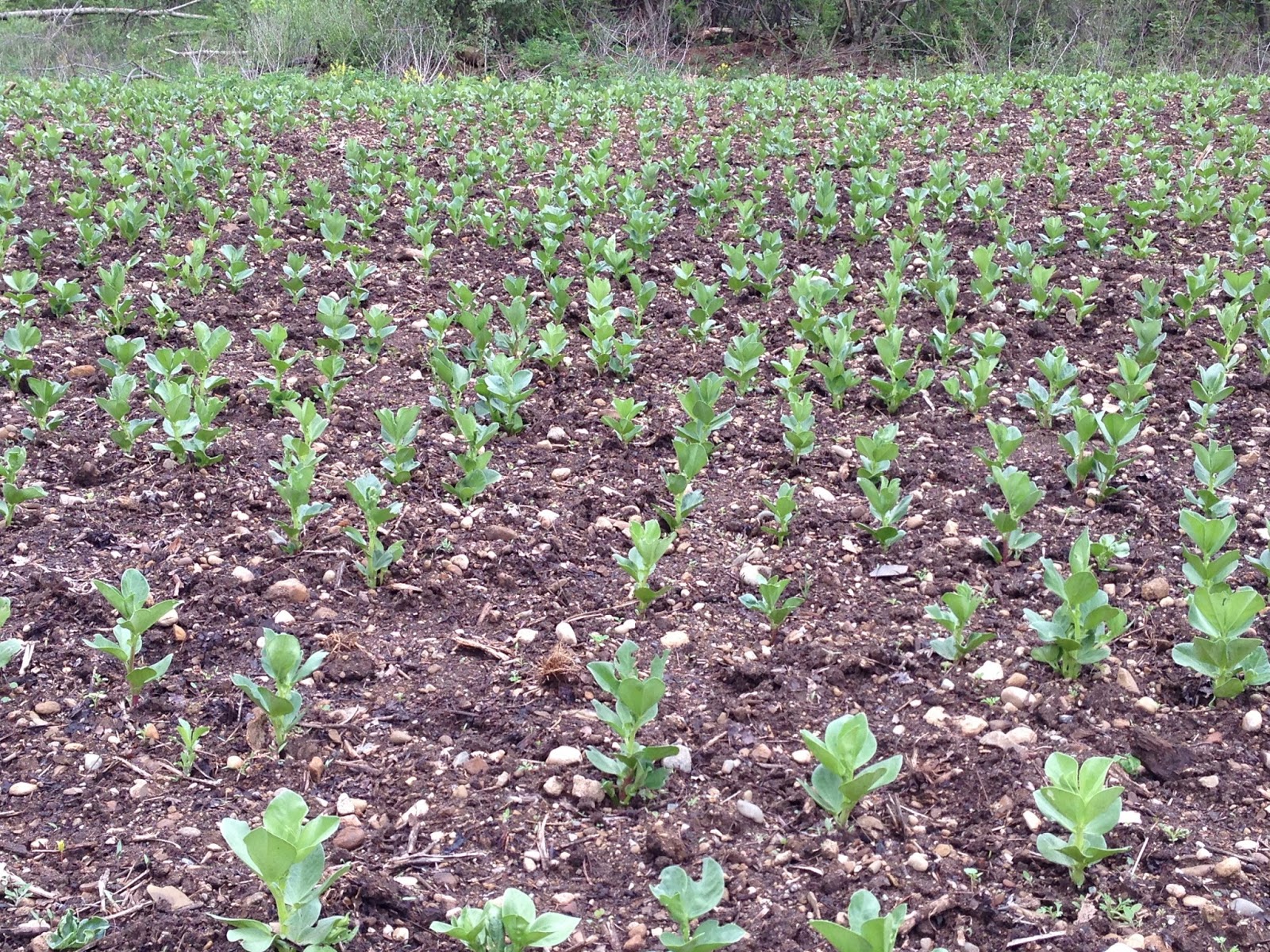
4) Fava beans are not as easy as I thought when I exuded enthusiasm over them this spring. The seeds we obtained were not able to outgrow the weeds, and weeding that size of a plot was a lot of work. Then the aphids took over and crippled the plants, being so thick the entire plant would appear black. I did not want to apply any commercial bug killers, and did not take the time to experiment with soap sprays-- life being characteristically busy right at that critical time. The beans we did get to maturity were not easy to harvest, shell or clean. I did not get even one good meal out of that entire plot. We used it as a cover crop, and tilled it in. As a cover crop, it may have been more expensive for seed and effort than it was worth.

5) Progressive planting is required for progressive harvests. Duh. Failure in the first, leads to... you get the point. Some things this year were just so delayed, like a month behind. Long season items (watermelon, cantaloupe, peppers, tomatoes, etc) took a lot longer to start producing, and that likely is just the result of a cooler summer. But the progressive harvests were missed out on again. I think for me the challenge is back to the weekly schedule, and regularly planting.

6) Home grown peaches are a dream of lovely sweetness. If at all possible, try growing peaches. No sprays (yet), and we had a small harvest this year. I can hardly wait to see how next year sets. Perhaps this next year we will get some of our other fruits as well.


If I think of more lessons, I will add to the above. Did you learn any lessons this year? I welcome your comments.


Sunday, February 3, 2013

Refugee Garden

I am not sure which of us thought of it first, as we have been kicking this idea around for so long. What about making a market garden training center focused on helping refugees? Refugees are people displaced by war & social unrest where they have had to flee their home country and try to start over in a new place. Refugees come to this country and are faced with a lot of traumatic life changes. They are in a new country, with a foreign language, customs, concurrency, employment system, etc. They are often familiar with agriculture in their home countries, but here in America they almost always occupy low paying menial jobs. Refugees often settle within the inner city of large urban areas. The children learn English faster than the parents, and role reversal upsets the family order. When old enough many of these refugee children join the military to master violence that they can use in the wars back in their home country.

Sunshine and Harvest have a dream of ministering to others via agriculture in a country setting.

We dream of a garden where refugees can come in peace and till the soil for their sustenance. Where they can work in agriculture  and do what they know how to do best, and stay connected as a family unit. Where they can learn English, grow produce for their family and to sell, earn an income for their family, and participate in producing wholesome food for their communities.

We are thinking about a project that would mentor and train refugees in a skill and open the door to an entrepreneurial, self employed business. We see better profit margins in organic growing, with strategic marketing to local consumers and outlets.

We dream of being able to minister to the soul and live out an expression of Biblical simplicity of a life of service.

We realize we don't have the required knowledge, or financial backing to make such a plan work. But we are thinking about how God will use us. Right now it seems more practical for us to minister to refugees here in the USA than go to a foreign land as a missionary family. We hope to touch people here that could then someday return to their home countries with the beam of Gospel light radiating from their hearts as well.

We are not the first to think of this idea. Following are some refugee gardens we want to learn more about


Tuesday, December 18, 2012

The Victorian Kitchen Garden

I am fond of 1800's history, and was pleasantly surprised to learn about the program "The Victorian Kitchen Garden". This apparently was a BBC series of the mid 1980's.

Source: Wikipedia on Harry Dodson
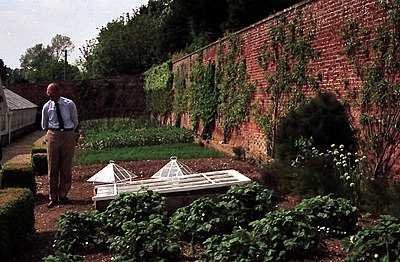
Back in the Victorian period (1800's) there were large walled gardens in each large estate in England. Food production was on a very local scale, and a team of people were employed as gardeners. All of this was new to me, but what I found especially interesting was to learn the tips and techniques from master gardeners of a hundred years ago. A time when there were no commercial fertilizers, few pesticides and a lot of attention to detail and the crop. There was no mono culture in these gardens!

The head gardener was one of the highest seniority staff members on the estate, and he was tasked with producing all of the food needed by the estate-- year round.

I have enjoyed the program, so I will organize links to the videos on you tube. I would caution you to beware of inappropriate content in the "suggested" videos area. It is sad to have good resources thrown in with the filth of a morals lacking society. Click the video link, and go full screen as soon as you can, and of course skip the ads if they are thrust upon you.

Note as of Jan 21, 2013, these video links are not working. The interview with Thoday is working which would give you an idea about the program.

April
May (first 10 mins)
July part 1, July part 2
September part 1, September part 2
November

Wednesday, October 31, 2012

Peanuts

When we evaluate the things we regularly eat, it includes a lot of grains. Along with the bread we daily eat, we enjoy peanut butter. All of us like it, and it seems we can use a lot of it.

We tried our hand at growing peanuts for the first time this year. We planted the nuts into the newest garden plot, just reclaimed from a bramble and forest. The soil in this plot is very rocky, and has minimal organic content. It is actually much closer to a gravel pit than I had imagined. While the peanut is a warm loving, southern favorite, I think most of our low production volume was related to the soil conditions.

We planted 1 lb of Virginia Jumbo peanuts, and harvested around 5 lbs. Many of the plants simply did not survive, and several had been severely cropped back by grazing deer. Those that did survive looked forlorn and in need of something more than they had. I was not sure if it was general soil nutrition, lack of water or pest pressure. All through the year the plants were small and seemed weak. We were almost resigned to think the crop had not produced at all, till we located some intact plants, and upon digging them up, we found peanuts!

Looking at how large the plants should grow, I think plant spacing should be 10 inches along the row. I think these plants would like long, warm temperatures, and I bet they would really like sandy soil. The areas were we had a lot of clay, they did not seem to do well at all.

The peanut shells are located off of "pegs" or flowering stems and bend down to the soil and the peanut develops under the soil level. At flowering time, you may want to loosen soil to assure the pegs can easily grow into the soil for pod production.

Back to where I started this post: we all love peanut butter. 1/2 a cup of peanut butter has been known to be consumed in at a meal. We prefer to make our own peanut butter by grinding roasted peanuts. After grinding, we place the jars in the refrigerator, and have no issues with the oil separating out. Ground peanut butter is more compact than whole peanuts, so it takes around 2 cups of peanuts to make a cup of peanut butter.

When you consider the work required to plant, water, weed, harvest, shell, roast, salt, store, and then grind; you can see this process takes a lot of work. And when you eat as much as we do, well, it gives you an appreciation of how much effort is required for this food item. We are not discouraged by the effort level, but I do see that we need a lot more land devoted to peanuts if we are to be self sufficient. I also think that if we were truly self sufficient, we would have to use less peanut butter. The total work involved is quite high, and it likely should be a "feast food".

If you have not tried growing peanuts, I would encourage you to try them. They were no problem at all, and just need some good soil. If you live in the north, get them going as soon as you can, as they like a long growing season.


Resources:

Thursday, April 19, 2012

Potatoes

Potatoes are a staple of our family. They are perhaps my favorite vegetable, and this year, we are growing a lot of them. By planting a lot of them, I am going to have to build a root cellar this fall to store all our harvest.

We have always enjoyed potatoes from the store, but when we grew our own for the first time, it was like an explosion of soft, tender flavor. "Wow" could be heard over and over around our table. Our youngest boy wondered if he had been transported to potato paradise. "These are the best potatoes ever!" I hope I have encouraged you to try growing potatoes. They are simple to grow, and don't take a lot of work to maintain till harvest. We had no pest pressure last year, and we are moving this years planting location to the other side of the garden. We hope if there was a potato beetle that we did not see, its larva will die before finding the location of the new crop.


Varieties

There are many varieties of potatoes. We have only tried a few, and will branch out over time to try more. If you are new at potatoes, try what other area gardeners suggest works well in your area. I suggest you get certified virus free seed potatoes. It is possible to plant again from your own stock, but I hear that the size of the potatoes will diminish over time if you have virus buildup.


Our history for 2012

April 19, planted:

Yukon Gold       75#
Red Pontiac         7#

We have found that 7# of red potatoes took up 80 feet of row space (one row). Also planted 50# of Yukon Gold, and we ended up with 4 additional rows of 80 feet. We have yet 25# to plant.

July 17: Counted up the potato early harvest: 560 lbs. This represents 6/10 of our planted rows,15 bushels. We sorted all of the potatoes and only the firm, uncut and completely dry potatoes went into the seller for longer term storage. Our rows are 90' and 6 rows equals 540 feet, yielding just over a pound of potatoes per foot of planted row.

When harvesting potatoes, we found some of the seed potatoes still intact, but soft or spoiling. We took care to sort these out of our harvest, to not spoil the new harvest.

August 2: Attempted a fall planting, by planting 1/2 bu of sprouting potatoes. We will see how this goes.

November 4: The second planting survived the early October frosts with just some slight leaf burn, but were dead by the end of October. We harvested perhaps 4 bu from the second planting. They were fine potatoes, but since the plants did not die down on their own, I think an earlier planting date would have been helpful to the yield.


Planting

It is suggested that you plant your potatoes about 2 weeks before your last frost. Potatoes can withstand some cooler temps, but not prolonged or hard freezing.

Potatoes can be planted in hills or rows. Last year we tried hills, and we did not have as dense or complete production as we would have had with a row. So, after testing it out, rows is our planting format of choice from now on. You set the seed potatoes 18 to 24" apart within the row, and set the rows from 3 to 5 feet apart.

We have a 3 point implement called a "middle buster" for setting a planting furrow. It will also work perfectly for digging the potatoes in the fall. We have seen this tool demonstrated by a friend last fall. We started with a straight track in the field, and then returned for the next pass and drove the wheel down in the previous track. This resulted in the furrows being just over 3 foot apart, which is perfect for potatoes.

Prior to planting, you can chit the seed potatoes by setting them in a warmer location, out of direct sun light. this will encourage the eyes to sprout, and speed up the early growth process. If you have sprouts, point the sprouts upwards. These will be stems for the plant. If you have large potatoes with several developing eyes, you can slice the potato into sections around each eye. Then each section can be planted on its own. If you do slice the seed potatoes, allow them to sit out for several days for the cut surface to harden a scab. This will help prevent rot that may happen if the cut potato was immediately planted.


Pests

Virus blight and insects are potato crop killers. Crop rotation will help in both cases.


Companion plants

Beans, cabbage, corn, and horseradish are excellent companion plants. Some even claim these make the potatoes taste better.

Tansy, nasturtium, coriander, and catnip planted nearby repel Colorado potato beetle.

Interplant potatoes with lettuce, scallions, radishes, and spinach. All of these crops mature fast and will be harvested long before the potatoes are ready to harvest.


What not to plant with potatoes

Avoid planting potatoes with tomatoes, sunflowers, raspberries, pumpkins, squash, and cucumbers. These plants may encourage blight.

Don't plant potatoes in an area that has been planted with any other Solanaceous crops in the last three+ years. This includes tomatoes, peppers, and eggplant.


Family story

Family history has passed down this true story: My great grandfather was Irish and a potato farmer in Iowa. At harvest, he had a wagon piled high of good sized potatoes, and with his horse team he pulled the load into town. Stopping by the grocery, he inquired as to how many potatoes he could sell.

The grocer came out to the street and said, "I won't buy any of your potatoes, not a one! These large Irish potatoes have a holes in them. My customers do not like the hollow space in their potatoes, and I will buy none from you!" My great grand father as convincingly replied, "Not a one of my potatoes has a hole!"  He picked a large potato from the pile, and taking his knife, sliced the potato in half. There to his dismay was a very large void -- a hole in his potato.

The story goes that he said nothing more, but got on the wagon and drove to another grocery. I would guess he limited his claims from then on.


Resources

Monday, February 13, 2012

Micro Greens & Sprouts

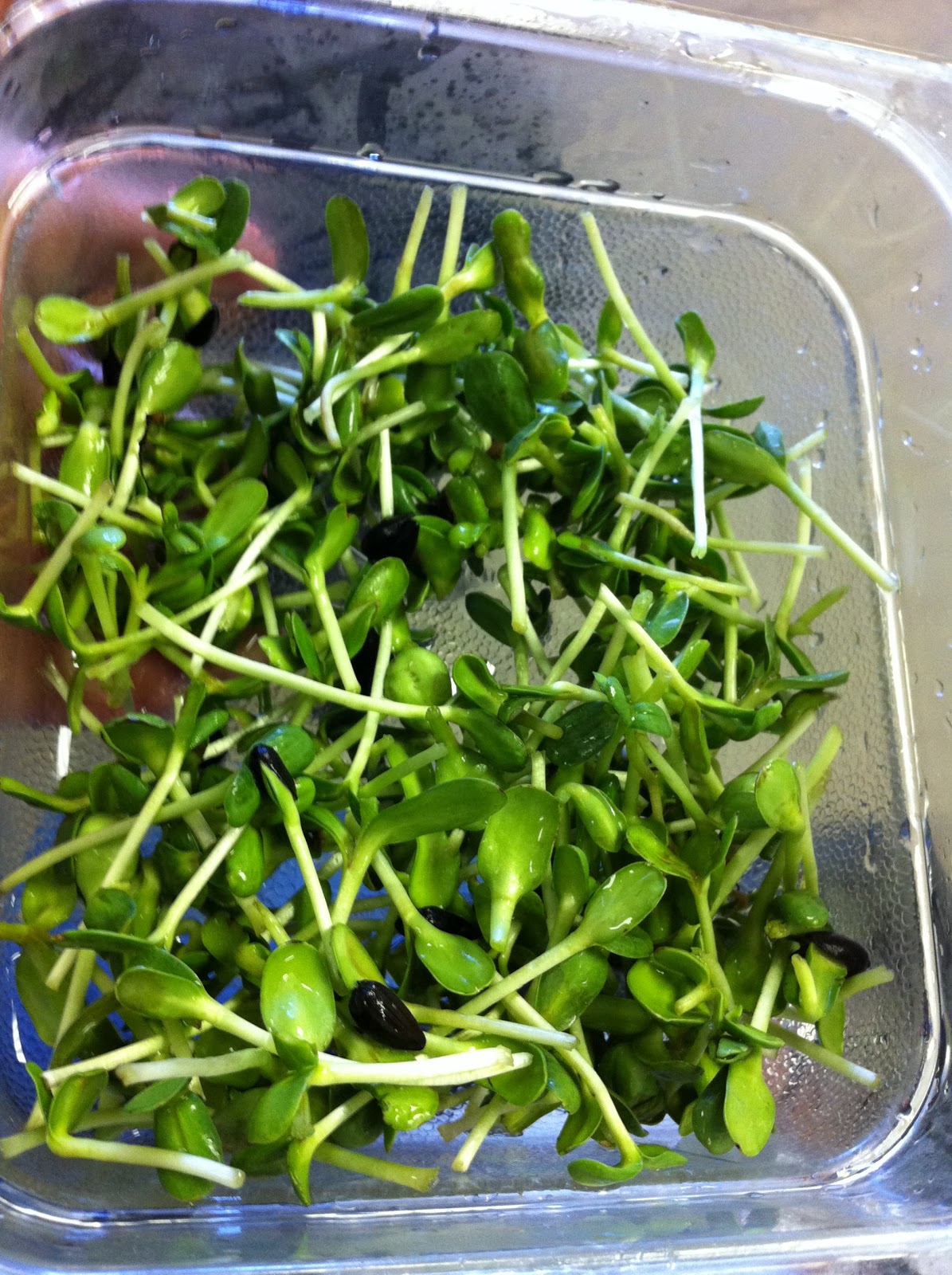
Microgreens are tiny leafed vegetables. Microgreens are just baby vegetable plants, used as greens. They are beyond sprouts stage, and are harvested when less than two inches tall. Some call them "vegetable confetti."

Commonly grown varieties of microgreens include: Amaranth, Arugula, Beets, Basil, Cabbage, Celery, Chard, Chervil, Cilantro, Cress, Fennel, Kale, Mustard, Parsley, Radish, and Sorrel. Several varieties can be mixed together to create combinations of tastes, textures and colors. The crops used for microgreens usually do not include lettuces because they are too delicate and wilt easily. Both baby greens and microgreens lack any legal definition. The terms "baby greens" and "microgreens" are marketing terms used to describe their respective categories.


Health Claims

There are many Internet sites that claim superior nutritional benefit from eating microgreens. As outlined in an article, Fresh Origins points out that most of these have not been backed up by scientific nutritional analysis. We need to be cautious about calling microgreens the next "wonder" food.


Why?

So why the interest in microgreens? For one the flavors of these small plants are almost explosive. You can enjoy a dazzling array of new flavors. Plants are at their absolute peak of flavor intensity at the microgreens stage of life.

The greens are easy to grow indoors, in a greenhouse or in a garden. Some refer to microgreens as the perfect counter-top gardening.

Chefs favor microgreens as a garnish, but these plants are versatile enough to be used as a sandwich topper, salad, in a soup or as a centerpiece to a main dish.


Growing Microgreens

Often microgreens are grown in trays with the seeds being dense enough to fill the tray with greens (as in the first image in this post). Many plants will grow fine with a mesh or fiber bedding and water. You can place around 2 cups of slightly acidic water in a tray with your seeds. Keep them in the dark for several days, and then expose them to light to green up for harvest.. A few plants do best with actual soil, such as sunflower, buckwheat, pea, cilantro and beet.

Various crops will be ready for microgreen harvest from 10 days to several weeks. You can experiment with the size of greens you prefer, and harvest as you desire. Since the plants will continue to grow, you have a range of sizes to choose from.

Sunflower, buckwheat, beet and pea all need to be pre-soaked in cold water.  Each should be soaked for 6 to 8 hours, except for beet seeds which should only be pre-soaked for an hour or two.

Amaranth, Bok Choi, and arugula do not like full sun. They do best with indirect light.


Sprouts

Sprouts are germinated seeds and are typically consumed as an entire plant (root, seed, and shoot), depending on the species. For example, sprouts from almond, pumpkin, and peanut reportedly have a preferred flavor when harvested prior to root development. Sprouts are legally defined, and have additional regulations concerning their production and marketing due to their relatively high risk of microbial contamination compared to other greens. Growers interested in producing sprouts for sale need to be aware of the risks and precautions, and oversight required by the FDA.


Resources

Wednesday, February 1, 2012

Food Safety

We all know that food safety is important. Eating contaminated food brings very upsetting gastric results. All of us likely have had at some time the unpleasant effects of food poisoning. Some forms of contamination can lead to death.

When I was young (a long time ago :), the concern I heard was about leaving meat and dairy out of the refrigerator, where it could culture harmful bacteria. These days we hear of massive food recalls, of both meat products and vegetables. What has changed that fruits and vegetables are now killing people like meat has for ages?

Recently there was a massive recall on lettuce and cantaloupe. Food that I have not considered at risk for e-coli contamination before. Thousands of tons of food has been destroyed in large multi-state food recalls. How is it possible that people in 18 states were made sick, 72 ill, 13 deaths, and that the contamination was linked to one farm? (web) The answer rests in how food is processed and packaged. We have monopolized and consolidated the food industry to a point that only a few companies control the entire food system. This is even of real food such as cantaloupes! (See my article on edible food like substances.)

It is really unfortunate that any food is contaminated, but it is worse to have this one contamination have such a large reach across the country! When I was a child, food was processed for a more local distribution area. Today, large companies will compete offering the lowest prices to grocery outlets. The way they obtain efficiency is in consolidating the packing processes to one large facility. They truck the food into and out of that facility. If contamination begins, it now has access to spread to a very large geographical distribution area. In this way, costs are lowered, but food safety risks are increased. Having to move food around like this is part of the reason we spend 10 calories of petroleum for every calorie of food. (Commercial fertilizers and pesticides made from petroleum, and fuel to power the massive equipment also consume petroleum.)

The corporate multi-national food industry responds to contamination issues as a mechanical problem. They gather their engineers together and come up with a bacteria control solution. Perhaps they can douse the food with stronger chemicals to kill the bacteria. Perhaps they can heat it so hot the threat is killed, no matter what happens to food quality. (After all if it does not look fresh, just add some artificial coloring chemicals.) It is a vicious cycle of adding chemicals to fix a broken system, and no one is looking at the root cause of the problem. It was the consolidation and mechanization that created the potential for cross contamination in the first place.

I do not believe that the solution to food safety is government regulation. This is not a problem the government will be able to correctly fix, because they are not looking at the root issues of what is wrong. Any response that does not bring food back to local responsibility is doomed to put more band-aids on a festering wound.

Eating locally grown food just makes so much sense! You eliminate the massive waste in transportation. You reduce the potential of cross contamination. You support your local economy, not the international corporate conglomerates bottom line. You know who grew your food. You know that no poisons were lathered upon what you will eat. You know it is safe to eat. The ultimate in eating locally, is to grow your food yourself.


On the farm

Perhaps we should turn our attention to more practical matters: how do we assure food safety on our own farms? Below are some ideas I would like to suggest:
  1. Keep animal products separate from vegetable prep areas. I would suggest dedicated cutting boards for each, and don't mix the two.
  2. Clean and disinfect sinks between uses, especially if preparing animal products.
  3. If canning, pressure cook low acid vegetables per USDA canning time and pressure recommendations.
  4. Keep produce as cool as possible, to the ideal temps per the food item.
  5. Wash hands often and for an adequate duration.
  6. Clean and sterilize lugs and storage bins between uses.

How safe is your food? Eat local.

Friday, January 27, 2012

Creating a Garden

Growing plants is a delightful experience. As artistic and colorful as plants, it is also how we survive, which adds a great reality factor to this endeavor of raising food. So how do you get a love for gardening? I think the first step is to expose yourself to the wonder of watching a seed germinate, and grow. Later, the gardener comes to realize that they do not have control of the seed, they simply cooperate with a higher power to sustains the seed and all life. We recently visited Sunshine's parents, and I asked them when they caught the love of gardening. Sunshine's Dad describes gardening as something that has just become a part of who he is. From a young boy to now advanced age, he has loved gardening.

And what about you and I? How do we get started with gardening and farming, if we did not grow up with our hands in the soil? How do we jump start the learning process, and become proficient ourselves? This article is to help break down the process a bit, and make it easier for your to create a garden this coming growing season. Perhaps you are like us, and have had a hobby garden, and are now ready to get serious with your farming activity, and want to expand your farm land, by reclaiming some existing ground around your home.


Garden size

The size of your garden would depend on your needs and produce goals. So, what are your goals? Do you want to feed your family with 80% of your food consumption for one year? Do you want to plan on extra for hard times or for your neighbors if they become in need? Find a realistic goal, and don't bite off too much all at once.

Several sources talk about 1/2 an acre being enough land to feed a family of 4. I agree this is enough to provide the vegetables for a family of 4, but it would not supply all of the grains that my family consumes in a year. Your growing season and soil quality should also be taken into consideration. Growing cycles per growing season is a key consideration. How many times can you produce a crop from seed to harvest in the growing season? With creative planning, you can sneak in an extra growing cycle and perhaps two. (More on the idea of maximizing growing cycles further down in this article.)

Three Stump Killers
Another consideration that you want to think about is sustainability, and land to allow growing green manures for building up your garden soil. I think it ideal to have a field you could alternate with green manures and vegetable crops. This effectively doubles the size of land needed for your crop production goals.


Steps
  1. Determine the largest plot or total plot area possible for you to farm. Note that I have increased what I thought was possible now three times, so count in the bramble patch, and perhaps even an area with trees, as the max potential you would have available.
  2. Determine the size of the area you would like to farm, regardless of the land available. If you want to farm more land than you have available, then you need to be more efficient with the space you have, and pray that the Lord leads to enlarge your borders. It may be a neighbor would let you grow crops on their land, or perhaps you could relocate.
  3. Clear the land if it has shrubs or trees. If there are large roots or rocks, it would be good to clear these also. When I have reclaimed land, I have removed what I could and I kept what I could not remove from the ground from growing again. What you leave in the soil will take years to rot away, and that after it has stopped trying to regrow.
  4. Take a soil analysis of the garden plot. I have written an article about why building your soil is important, and how to take a soil analysis.
  5. Amend your soil based on the soil analysis results to build the soil back to ideal nutrient quantities. Consider how to introduce organic matter to the garden. If the soil has not been actively improved, I would bet it could use more organic matter. Adding organic material to your farm will be one of your constant tasks. To impact the organic matter percentage of a large garden will require massive inputs of organic material.
  6. Gather the materials you will use for mulch. If you have access to manures, obtain as much as you plan to use for several years, and allow it to age and heat in a mound to kill the weed seeds. Note, you do not want to till in low nitrogen materials into your soils. The effect will be to rob the garden of nitrogen. Mulching on top of the soil is suggested, but remember if you mulch with wood chips, it may take several years for these to break down sufficiently to incorporate into the soil. Plan on adding nitrogen to wood chips and straw.
  7. With your goal dimensions in mind (from #2), set out your parameters and draw it out on paper, with dimensions. Note the lay of the land, and any shading that may impact your garden space. This drawing will be the basis for your garden planting and rotation plan.
  8. Figure out how much of each crop you would like to harvest. (Crop yields, garden yields). Your plan could be as elaborate as how much your farm will distribute each week via your CSA, or as simple as our plan to put up 104 quarts of pickles for the season, providing 2 quarts per week.
  9. Decide when you will grow what crops. Remember your predicted last frost date in the spring, and the first frost date in the fall. Here is a CSA harvest schedule as a sample, another, another, and another. (If you are launching a full blown CSA, you have a lot more work to do than I will list here in this article. Review the Community Supported Agriculture (CSA) Resource Guide for Farmers.)
  10. Layout your planting plan, based on what you need to grow, by row foot. Depending on the slope of your land you may want to lay out your rows with or parallel to the slope. If slope is not a factor, many references suggest planing your rows stretching north to south. The tall crops such as peas, beans and corn, should be planted on the north side of the vegetable garden. In this way they will not shade the rest of the vegetable crops.
  11. Determine your planting schedule, and what plants you want to start for transplants to get a head start on the growing season. Remember that you want to stretch your harvest out, so progressive plantings should be in your plan. For example: plant some lettuce every other week for a steady harvest of greens. You will need to have room for these future plantings. If you can fit in a cover crop, all the better!
  12. Weed the garden on a schedule. While your seedlings are small, keep the weeds down. When your vegetables are larger, mulch heavily to keep out the weeds, and improve the growing conditions. This pattern will greatly reduce the amount of work you have to expend on your garden in both weed control and watering.
  13. Take good notes. There is no way to recover information if you do not record it. Take notes on your planting, dates, pests and yields. You can use these records to create next years plan, and remember to rotate your crops.
  14. Try something new each year, just as an experiment. Try a new variety or new gardening method.

Remember the first year in a plot will likely not be the best year. If you have followed these steps, especially adding the amendments that the soil needs, I think you will have a fine harvest.

Also review the article: Creating an Orchard

Monday, January 16, 2012

Tractor Safety

Farming is a dangerous profession, and there is one item that creates this risk: the tractor. I personally know several people who have been killed on their tractors. The most likely cause of death is the tractor rolling over and crushing the driver. There simply is not enough time to jump free. Do not consider this your avenue of escape. Tractors can tip to the side on an incline. They can also tip nose up and overturn. ROPS (roll over protection systems) and seat belts save lives. Do not operate a tractor without both of these safety systems.

The next dangerous area of a tractor is the PTO. This rotating shaft at the rear of the tractor that can lead to death or worse. I don't want to be graphic. Loose clothing can be caught in the PTO, and faster than it takes to tell about it, you can be wound around the shaft and loosing body parts left and right. Never wear loose clothing around a tractor, and never approach an engaged PTO. Note: the tractor will not stop or bog down even if you or body parts are being wound around the shaft.

The older the tractor, the fewer the safety systems will be available. Some older tractors do not disengage their PTO. This means that you can not turn off the PTO in some situations where you would like to, and if connected to an implement, it is always working. This makes these older tractors especially dangerous. Get a tractor that you can disengage the PTO.

Some tractors have one nose wheel, like a tricycle, called row crop tractors. This wheel configuration narrows the wheel base, making the tipping potential greater. I suggest you avoid this type of tractor.

I have experienced the nose of the tractor rising when pulling a large stump from the ground. Be prepared and don't overturn.


One person dies in a tractor accident nearly every day in the United States, according to the National Institute for Occupational Safety and Health (NIOSH). Don't be a statistic, think before you move, and anticipate danger.


Resources:

I considered these articles when we were looking for a good farm tractor:

Our tractor wish list items:
  1. Has or able to add ROPS and seat belt
  2. Spread front wheels (not tricycle)
  3. Has rear PTO, able to disengage.
  4. 32 - 45 hp. You need power in this range to plow.

Our tractor selection:
  1. Kubota 3800, 38 hp
  2. 66" wide front end loader
  3. 7.7' backhoe
  4. box blade
  5. single roll over plow
  6. small disc unit
  7. single tine chisel (considering)
  8. rototiller (considering)
  9. mower (later)
  10. snow blower (later)

Tuesday, December 27, 2011

Land

Land is the foundation of farming. Is is the capacity to feed yourself via crops. Land grows the wood lot which offers wood to heat your home, water and food. Land provides an environment of growth and development for your family. Farmers, gardeners, yes all of us love our land. As I have grown older, and perhaps wiser, and I have moved around the country several times, I realize that the land we own is truly just ours for a short time. We are stewards of the land we own. If time will last, our land will surely outlast us.

My interest in land has grown as I have wanted to enlarge our family garden enterprise. Without tillable land, we can have interest but may be limited in our production potential.

How much land can you work effectively can be calculated by the number of people working the soil, the type of crops, your environment and soil type, how intensively you will grow crops, and what machinery will assist you in the farming process. One farmer friend in West Virginia estimates that one person can handle from one to two acres of vegetable garden without mechanical equipment. Techniques can be employed to improve efficiency, and over a period of years, weed pressure is decreased.

For those looking for land, the key criteria are: 1) room for crops in tillable land and room for nutrient fields of cover crops and crop rotation, 2) wood lot with enough trees to sustain your wood heating needs, 3) available water.


As I have looked for land, I have added these criteria (from a list made in 2010):
  • 20+ acres
  • Water available
  • Land suitable for food production
  • Wood lot suitable for heating and cooking
  • Remote, with lower immediate population pressure, but have outreach potentials
  • South facing land for crops, north facing for fruit trees
  • Opportunities for nature / hiking / camping in the greater community
  • Some elevation change would be preferred for a basement walkout, root seller, and water gravity flow
  • All acquisitions be dept free
  • Scenic vistas would be enjoyed

I do not know what to suggest for the quantity of these three root criteria. A large part of the equation is how many people you will be having work in your enterprise. For an independent family farm, by current guess at a minimum would be 20 acres. A promise from inspiration: "God can bless twenty acres of land and make them as productive as one hundred..." 5T 151.3 The context of this quote is that we need to guard against amassing or hording land in greed. Other references balance this with the encouragement for schools and sanitariums to obtain as much land as possible as a buffer around the institution. Some of these recommendations specify into the hundreds of acres.

One thing is clear, we do not want to make our land our idol. We should ever be ready to heed God's call or public coercion to abandon it. If we amass a fortune of time and wealth in land, surely it would be hard to leave it. In these last days of earths history, we should heed the Biblical counsel to "remember Lot's wife."

I know of a CSA farm in middle Tennessee which comprises over a hundred acres, supports four families plus interns, and of this total they have under 10 acres in tillable production. Another CSA farm that focuses more on large machinery has 1200 CSA customers, and utilizes around 150 acres of production. So the volume parameters are very diverse, depending on the situation and plan.

In upcoming posts, we will deal extensively with amending your soil to achive a perfect balance of nutrients and physical and biologic qualities for growing excellent crops. It should be noted that land weighs in at 4 million pounds at the top 12 inches of soil, which is your effective gardening depth. With this kind of volume, it is impractical to think of changing a soil type. You may be able to nudge the organic matter in your soil, but you will not be able to change a clay soil to a sandy soil of vise versa. It is simpler to purchase land suitable for crops than to work in vain to try to change it.

Some encouragement from inspiration related to your land:
"In God's plan for Israel, every family had a home on the land, with sufficient ground for tilling. Thus were provided both the means and the incentive for a useful, industrious, and self-supporting life. And no devising of man has ever improved upon that plan." MH 183.3
"Many do not see the importance of having land to cultivate, and of raising fruit and vegetables, that their families may be supplied with these things. I am instructed to say to every family and every church, God will bless you when you work out your own salvation with fear and trembling, fearing lest, by unwise treatment of the body, you will mar the Lord's plan for you." MM 296.6
"To parents who are living in the cities, the Lord is sending the warning cry, Gather your children into your own house; gather them away from those who are disregarding the commandments of God, who are teaching and practicing evil. Get out of the cities as fast as possible. Parents can secure small homes in the country, with land for cultivation, where the children will not be surrounded with the corrupting influences of city life. God will help his people to find such homes outside the cities." RH July 5, 1906 Par. 30
 May we claim this last promise for ourselves. If you are longing for land for cultivation, and to live in a rural environment, this promise is for you to claim. God will answer!

Sunday, December 25, 2011

Introduction

Our family is not your stereotypical farming family. We have to look back to our great grandparents for ancestry that subsisted by farming. My wife (Sunshine), is a nurse by training; and I (Harvest) a teacher, physical therapist, and businessman. We have always enjoyed a small supplemental garden, but we are now launching into farming as a new chapter in our life experience. We embrace this activity with our two sons, who will be key to our success. At 10 and 12, they are able to carry a man's load of the enterprise.

We have many reasons and goals that make agriculture a good fit. As society comes apart at the seams, we want to represent a cohesive family. As food represents 10 times more petroleum calories via production and transportation than from the food itself, we want to work with our hands, and offer locally grown food to our neighbors. As food security and safety is more and more a problem, we want to grow wholesome, pesticide free, mineral rich food. While others turn to genetic modifications and chemical farming, we seek plants that reproduce "after their own kind" Gen. 1:11. As interpersonal relationships decline to shallow posts and isolation, we want to form a community of meaningful community relationships. While the world looks for leisure and ease, we want to embrace the idea that growing your own food requires physical work. While the world denies a higher power, we welcome the goodness of God and seek to partner with Him in all we do, and we see His footsteps next to ours along our garden paths.

There is a joy of working with the soil, and we embrace this joy into our lives. We have enough to share with you as well. We desire to outline our experience, and encourage you to consider joining us in a similar life endeavor. We see small market gardens and farms, like rays of light, dotting the landscape and feeding our communities across this land. We invite you to consider standing on our shoulders, and advance the cause we have now begun. Feel free to improve on what we have started. Make your farm your own. Side-step the mud puddles we may get stuck in. Move directly to profitability in family character building, outreach potential, and even financially. At the same time, know that the goal will not be to avoid trial and perplexity. You will have plenty of these, just as we do.

Part of this blog will be sharing what we have learned from others; part will be pure from our own experience. Some posts will be a blend of the best information that we have gleaned, and our hands-on experience. Some posts will be instructional, while other posts will be historical: news as it happens in our farm.

The sun has risen. Let's get to the chores. God bless your day!