Showing posts with label propagation. Show all posts

Tuesday, December 18, 2012

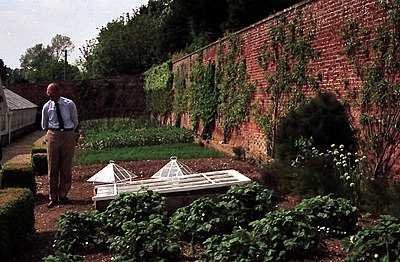
The Victorian Kitchen Garden

I am fond of 1800's history, and was pleasantly surprised to learn about the program "The Victorian Kitchen Garden". This apparently was a BBC series of the mid 1980's.

Source: Wikipedia on Harry Dodson
Back in the Victorian period (1800's) there were large walled gardens in each large estate in England. Food production was on a very local scale, and a team of people were employed as gardeners. All of this was new to me, but what I found especially interesting was to learn the tips and techniques from master gardeners of a hundred years ago. A time when there were no commercial fertilizers, few pesticides and a lot of attention to detail and the crop. There was no mono culture in these gardens!

The head gardener was one of the highest seniority staff members on the estate, and he was tasked with producing all of the food needed by the estate-- year round.

I have enjoyed the program, so I will organize links to the videos on you tube. I would caution you to beware of inappropriate content in the "suggested" videos area. It is sad to have good resources thrown in with the filth of a morals lacking society. Click the video link, and go full screen as soon as you can, and of course skip the ads if they are thrust upon you.

Note as of Jan 21, 2013, these video links are not working. The interview with Thoday is working which would give you an idea about the program.

April
May (first 10 mins)
July part 1, July part 2
September part 1, September part 2
November

Tuesday, February 28, 2012

Greenhouses

A greenhouse is a weather protecting structure for your garden plants. It could be as simple as a cold frame (a low wooden box covered with glass) to a tube frame, plastic covered high tunnel, to a stud framed glass house. With a greenhouse it is easy to extend your growing season a month earlier in spring, and a month later in fall. Depending on your greenhouse, and your crops, you can extend your harvest into winter.


Uses
  • Seed starter greenhouse
  • Forth season production
  • Flower / cash production

Important concepts
  • base temperature
  • optimum temperature
  • temperature integration
  • photo period
  • irradiance
  • poly sun degradation

Design considerations

The ground warms and cools with the surrounding temperatures. As we cover the ground with the greenhouse, the earth under the house can offer stored heat. Utilize this heat battery to your advantage. In sunny areas, the solar input of energy will be more significant than earth heat radiation. If you are using glass for your glazing, then you will want to orient the angle of the glass to the perpendicular to the elevation of the sun during the winter. This angle is your latitude at the winter solstice. You want the angle of incidence to be low so that most of the light will completely penetrate the glass, and not loose some of it through reflection.

Using a GPS, property map or Google Earth, determine the latitude of your location. Add between 10 and 20 degrees to your site latitude to determine the orientation of your greenhouse glazing. For instance, if your latitude is 35 degrees north, your glazing should be angled at a 45 to 55 degree angle.


Heat storage / sources
  • Water stored inside the greenhouse, in black containers to absorb as much daytime heat as possible. This heat would then be radiated at night to moderate temperatures. One friend of ours has used 55 gallon metal drums full of water in the center of their greenhouse with planter boxes on top of the drums. Another has water containers on the backside of the greenhouse. Another greenhouse we reviewed had a small pool of water within and under the floor.
  • Rock mass as a thermal heat sink. Another greenhouse we have reviewed has a rock wall on the north side of the lean-to greenhouse. Another example is a solarium made with massive amounts of rock as thermal mass.
  • Earth-air tubes are tubes buried deep in the ground and air passed through the tube to take the constant heat from the ground into the air and then into the greenhouse. Electricity is needed to move the air.
  • Below ground radiant heat, with heat being added from a boiler or solar heater.
  • Wood stove heater within the greenhouse.
  • Greenhouse lowered into the surrounding ground, to encourage more earth-heat coupling.
  • Cold sink trench within the greenhouse to hold coldest air down within the soil.

Resources

Thursday, February 9, 2012

Pruning Fruit Trees

Pruning a fruit tree is a critical step for tree growth and fruit production. There is a variety of ways to prune trees, and some types of trees have different needs. I am a learner in this topic, so we will start with listing resources I am using to practice and learn techniques related to pruning.


Goals of pruning
  • Remove dead wood
  • Remove any crossing branches
  • Open the tree to get even sunlight and good air movement

When to prune

You do not want to do heavy pruning during the active growing season, but you need to take care that you do not prune just before a cold snap either. Pruning is reported to lower a trees cold tolerance. It is suggested that you prune trees just before they bud out which would be after the danger of really hard freezes and very low temperatures. The larger the tree, and the older the tree, the more able it is to withstand cold after pruning. Apples can withstand winter pruning better than peaches.


General methods and techniques

Apples

Cherries

Pears

Peaches

Plums
  • Plum trees should be pruned in the spring, to minimize fungus attack.

Monday, December 26, 2011

Diversity

When you are planning your farm, you need to think about diversity. Mono crop farming is not being self reliant. You are growing one crop, in the desire to sell that crop and then purchase what you need. While I don't suggest the goal is financial isolation, the model of years past was not mono crop farming. It is not sustainable or self-supportive if one crop fails, or you fail to find a buyer for your one crop. The idea of independence is harmonious with diversity. Farmers of the past may have had a cash crop, but they also had a personal garden to support the variety of food needs for their families.

Diversity is good for being able to supply all of your home needs. It allows you to offer this same diverse spread of food for your customers. It protects against a complete loss with one crop failure. Diversity allows more complete crop rotation, in mini-rotation cycles, and ultimately aids in soil-development.

Currently, we are participating in four areas of farm diversity as self support and cash crop income. Our current list is: 1) full spectrum vegetable crops, 2) perennial fruit crops, 3) plant propagation and 4) animals. Items we could add in the future: medicinal herbs, essential oils, candles, wood fuel, fiber arts, crafts, flowers (fresh or dried), CSA/ASC, farmers markets, road side vegetable stand, and I am sure the list could continue to even more diversity.


Vegetable crops: are naturally diverse, and we want to offer a balanced diet with our produce. Garden development has a lot of pre-work, in amending and healing your soil to be balanced, complete and mineral rich, good organic matter content, etc. Some vegetables will grow best in your area, and we suggest planning your balance from what your climate and area supports best. For homestead use, you will want to plan on your food preservation and storage capacity. For public sales, you will want to find the best interface in your area. Some venues to consider: road-side stand, CSA/ASC, restaurant contracts, grocery wholesale, and/or farmers market. You can consider the time of picking, and quickly chilling food in the field to preserve freshness.

Some farmers we talk with enjoy the CSA/ASC repeated contacts with their customers, while others find the weekly schedule rigorous to fulfill a weekly demand. While I am suggesting diversity, you need to start only what you can handle, and this likely means you need to ramp up what ever production level you want to commit to in a sane and family friendly way.


Perennial fruit crops: these range from easy to hard depending on the types of fruit to be grown, and the climate and pest pressures around your farm. In Michigan, it was common to hear of some fruit crop failure each year.

The list would include: apples, pears, peaches, apricots, plums, pomegranates, nut trees, grapes, raspberries, black berries, blue berries, strawberries, etc. The advantage of the perennial fruits is that they are generally more established, and require less frequent intensive care as compared to vegetable annuals. In some areas, fruit pests are a problem, and bringing organic fruit to market is a challenge. We need to educate consumers that surface imperfections are not the problem, rather insecticide drenched fruit is the problem.

Customer contact could be similar to the vegetable markets. I have seen one organic tree farm offer a "rent a tree CSA" in which you could purchase the produce to be harvested (and even harvest it yourself) from one specific tree. This makes a direct connection between the tree and the customer, which is very satisfying.


Plant propagation: is working with trees, bushes, ornamentals, etc, where you are multiplying a plant. The focus could be on developing stock for your own orchard, or to sell as a cash crop. It can still be diversified but time is the key. Taking cuttings, allowing them to root, grafting if needed, growing to sell-able age, will in total be several years.

Find markets for plants, and focus on what these markets need. Plan to offer your product at a good price when entering a new market, but establish being local to your advantage. Avoid the rush to the bottom when it comes to price. You could sell retail to the public, and consider mail order options as well. I would think that wholesale to a store would provide more volume, especially if you are in a very remote or rural location.


Animals: are a long standing tradition for historic farms. Farm animals were used to assist with farm work, like oxen and horses to production animals such as chickens and bees. There may be interest in milk or hair products (fiber arts) from various animals. Some animals would require significant infrastructure and tools, such as dairy barns, and milk processing facilities, or bee hives and tools. Expand as your knowledge can afford and as the Lord opens the way.


So, how can you diversity? Consider the options available to you, and the income sources that may avail you a living and support your budget. I encourage diversity as long as you can effectively give adequate attention to the existing operation. The word for today: diversity.