Friday, November 22, 2013

The Foreman

I came across an interesting story, that I think relates a lot to how we want to train our children-- to be capable adults. From cooking, canning, garden work, tractor work, or good old manual labor... we want our young people to be masters and able to lead.

So, here is the story:

"In some respects the pastor occupies a position similar to that of the foreman of a gang of laboring men or the captain of a ship’s crew. They are expected to see that the men over whom they are set, do the work assigned to them correctly and promptly, and only in case of emergency are they to execute in detail. 
The owner of a large mill once found his superintendent in a wheel-pit, making some simple repairs, while a half-dozen workmen in that line were standing by, idly looking on. The proprietor, after learning the facts, so as to be sure that no injustice was done, called the foreman to his office and handed him his discharge with full pay. In surprise the foreman asked for an explanation. It was given in these words: “I employed you to keep six men at work. I found the six idle, and you doing the work of but one. Your work could have been done just as well by any one of the six. I cannot afford to pay the wages of seven for you to teach the six how to be idle.” – ChS 70.2

Thursday, October 31, 2013

Planting Garlic

We planted 30 lbs of stiff neck garlic yesterday, and for lunch we savored each variety. I enjoy the varieties. Each has its own flavor and taste personality. Some have a mellow heat and rich flavor, others pop with an instant flavor.

Garlic likes rich, well draining soils. It is suggested that you rotate your plot each year to be sure there is not a build up of pests in the bed. The location we are using this year has never had garlic in it before. In preparation for planting, we tilled and smoothed the soil in the garden plot. We set out the paths per our tractor wheel base at 30 inches of bed space.

We broke the garlic bulbs apart, but kept the paper wrappers on each individual clove. A few hours before planting, we soaked the cloves in a nutrient solution of 1T baking soda, 1T Kelp liquid into 1 quart of water. Then just before planting, we dipped the cloves into undiluted isopropyl alcohol (70%). We have been told the alcohol dip will not damage the cloves, and may discourage bacterial and fungal influences.

For planting, we prepared a bed 30 inches wide, and within this bed we made 4 equal spaced rows for the garlic, approximately 6 inches apart. Within the row, we planted the cloves from 4-6 inches apart and at a depth of around 3 inches. Last year we had garlic cloves pushed out of the ground because of freeze thaw, so we have planted them a bit deeper this year (3-4 inches deep). Our plan is also to cover the area with straw and mulch. A friend has read that you should let the ground freeze, and then place the straw on the bed. This would help keep the ground shallowly frozen, and decrease the freeze thaw cycles during the winter. If you find your garlic heaving out of the ground, then you need to cover it with soil, and plan to plant deeper next year.

Varieties we are planting:
  • Chesnok Red, Purple Stripe
  • Russian Giant
  • Porcelain Musik
  • Porcelain Romanian Red
  • Silverskin S & H (softneck garlic)
The stiff neck garlic is a special, gourmet garlic. It brings a high price and is of excellent cash crop. It is easy to grow, and in our experience has few pests. I am not sure why the small gardener would not want to try it. If fact I think everyone should!


Resources:
  • See our earlier post on garlic.

Wednesday, September 25, 2013

Gardening lessons from 2013

This growing season has been a good year for learning, and gives hints of a lot more yet to learn. I thought I would record some of the take home lessons that I want to remember in the future, and that you may find valuable as well.

1) Weeds grow fast. Weeds hurt a garden. Removing weeds takes a lot of work (and sweat). Since the sweat of my brow is the title of this blog, I have put this item first. Weeding takes time, and there are critical periods to perform weeding where if you don't kill the weeds when small, they will forever later be an issue for the garden.

a) Wire cages make it really, really hard to weed inside the cage.
b) Row widths need to be wide enough to run a tiller down the path to help cut down the work. One foot of walkway may be harder to keep clear of weeds than 3 feet of walkway, if you have a tiller to help chew through the path, and throw dirt up on the weeds in the growing row.
c) Plastic ground cover does a very good job of keeping out weeds. We put down plastic for the first time this year. We used it under our sweet potatoes, and had very good results.
d) Wood chips are great for weed control. The occasional weed that does come up is easily pulled out.
e) Weeding the entire garden on a rotation schedule would be ideal, and not let it get out of hand. To be honest, I am not sure if I have ever had complete control of weeds to date, so this is a goal.

2) Wood chips may slow down vegetable growth rates. It is hard for us to separate out the cooler summer here in the north country but crop harvest dates are way late. Some of the difference seems to have been that we planted our melons in an area covered with wood chips. (Just to be clear, we moved the chips aside, and planted in soil, with the melons growing out over the wood chip area.

a) The climate over the wood chips may be cooler and slow melon development.
b) The wood chips may have interacted with the top layer of soil robbing it of nitrogen. Note we have taken great care not to till in the wood chips into the soil, so I was not as concerned about nitrogen loss.

3) Spraying with something is required to preserve the harvest. I started the year a bit optimistic, that grapes could be managed without spray. This was my first year for a grape harvest, and I have now been educated. I could handle the bugs with a vineyard small enough to manually police the vines on a regular bases, and manually destroying the Japanese Beetles present. But with heavy spring rains, our grape bunches developed black rot, and we lost about 50% of our entire crop. We would have lost 100% within another week, but I was able to halt the fungus with an organic spray of copper sulfide solution. Now I know this should have been applied proactively, not reactively.

Apple scab took out most of our apple harvest this year. I did not spray at all, and should have. We had two apples stay on one tree as our total apple harvest, and they were badly marked with apple scab. Apple scab is a significant issue, and I am not impressed with our apple varieties resistance. Only the Galarina seems unscathed by the apple scab. Crimson Crisp show susceptibility to leaf curl and apple / cedar rust. It is doing the poorest of all our apple trees. Complete leaf cleanup this fall, and early spraying next spring may allow a harvest next year.

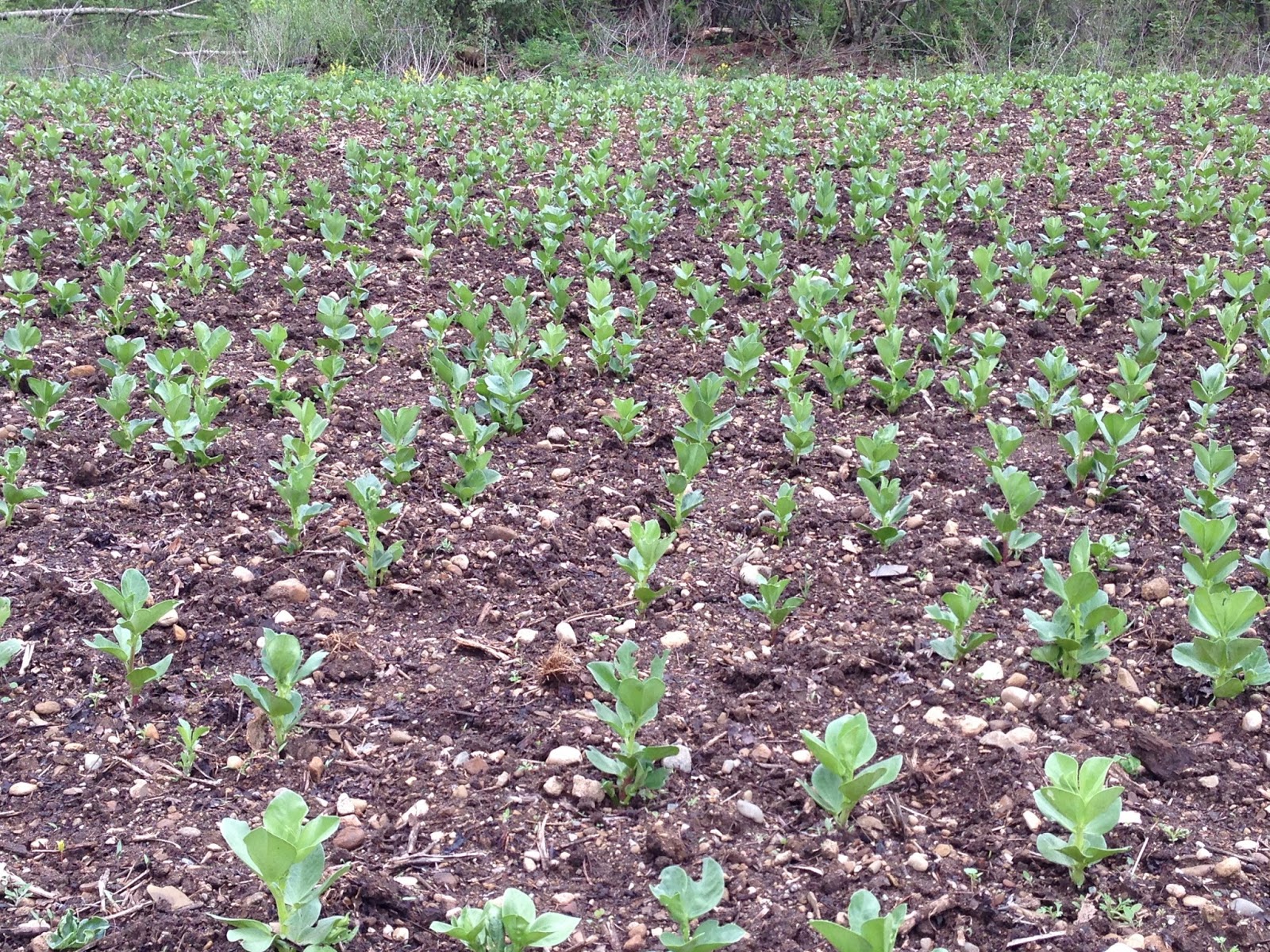
4) Fava beans are not as easy as I thought when I exuded enthusiasm over them this spring. The seeds we obtained were not able to outgrow the weeds, and weeding that size of a plot was a lot of work. Then the aphids took over and crippled the plants, being so thick the entire plant would appear black. I did not want to apply any commercial bug killers, and did not take the time to experiment with soap sprays-- life being characteristically busy right at that critical time. The beans we did get to maturity were not easy to harvest, shell or clean. I did not get even one good meal out of that entire plot. We used it as a cover crop, and tilled it in. As a cover crop, it may have been more expensive for seed and effort than it was worth.

5) Progressive planting is required for progressive harvests. Duh. Failure in the first, leads to... you get the point. Some things this year were just so delayed, like a month behind. Long season items (watermelon, cantaloupe, peppers, tomatoes, etc) took a lot longer to start producing, and that likely is just the result of a cooler summer. But the progressive harvests were missed out on again. I think for me the challenge is back to the weekly schedule, and regularly planting.

6) Home grown peaches are a dream of lovely sweetness. If at all possible, try growing peaches. No sprays (yet), and we had a small harvest this year. I can hardly wait to see how next year sets. Perhaps this next year we will get some of our other fruits as well.


If I think of more lessons, I will add to the above. Did you learn any lessons this year? I welcome your comments.


Friday, September 13, 2013

Small Fruits / Berries

Eating fresh food from the garden is especially beneficial. And if you accept this idea, then you must with me conclude that there is something in fresh food that will degrade over time after harvest. Since the macro molecules seem rather stable, I can conclude that these beneficial elements must be the fragile phyto-nutrients and anti-oxidants in fresh food. A portion of our diet likely should be raw food. Note this quote:

"All should be acquainted with the special value of fruits and vegetables fresh from the orchard and garden." CD 312.4

If you study about the colors of foods, you will find some common health characteristics with the foods of a similar color. Try to have a rainbow diet: reds, yellows, greens, whites, blues, purples. Adding a lot of color variety will assure you are getting the maximum nutrition from your food.

There is a lot of scientific research related to anti-oxidant properties of foods, and how these protect the human body from really had diseases, like cancer, hypertension and atherosclerosis. We want to be healthy, not only for the reason of living longer, but that the quality of the years we do live will be improved. The end result of our lives is that we may daily do what best pleases the Lord. (Eph 5:10)

So let's just pause a moment, and survey some of the anti-oxidant research, and then see what foods percolate to the top of the list containing these helpful chemicals.

If you read just the titles, you will be impressed by the health benefits of these berries! This fall and next spring, we are expanding our farm into more berries, and will experiment with many of those listed above. Enjoy good health by expanding the colors of your foods, and make these berries a regular part of your diet.

In 2016, I planted two types of purchased Raspberries in the lower field:

  • Double Gold Raspberry
  • Joan J Primocane Red Raspberry


Resources:

Friday, August 9, 2013

Seven Thousand

Think back to the story of Elijah after the Mt Carmel experience, during his flight from Jezebel's wrath. When he finally stops running, he is in Mt. Sinai, and God talks with him there. Elijah, what are you doing here? To this Elijah gives a list of problems, chief of which that Jezebel seeks his life! Then he says, Lord, I am the only one left. No one else serves you! (Read 1 Kings 19:13-18.)

God gives Elijah several tasks, and ends by saying "Yet I have left me seven thousand in Israel, all the knees which have not bowed unto Baal, and every mouth which hath not kissed him." v.18.

When Elijah felt all alone, there were others, many others in God's service. We know that in our day, the close of earths history, God's true followers will feel alone and abandoned. So I think there is truth here in this story that will mirror our experience. There are lessons here that will be relived through our lives today.

Let's be frank. Those who want to serve God have always been a minority. We think of a straight and narrow path leading upward. While on the other hand, there is a broad and easy pathway leading the majority onward. Suffering and persecution is the hallmark of the experience of God's people, and on the surface, this is not the most compelling draw to the carnal mind. In the end times, many will be in lonely and solitary situations. We may not know of another person who is serving God till the very end. We should expect to have the same perception as did Elijah, that there is not another in the whole of the earth who is serving God.

But the Lord gently rebukes Elijah. The very question, "What are you doing here?" indicates God's ideal would have been for Elijah to have been back in Jerusalem. We can imagine there was a lot of work for God to be done in Jerusalem just after Mt. Carmel. But the one man called to that task was no longer there.

Perhaps Elijah made a jump in thinking, that because he was the only one called to represent God on Mt. Carmel, that he was the only one left in  God's service? Let us not make our singular calling equate to the strength of all of God's service. When things look the darkest, God is preparing a dawn. When there seems no way out, God will open a highway right through the middle of a sea. When called to the gallows, God may see fit to use your blood as seed for His kingdom, or He may with miracles rescue you. It matters not to us, but that we stay at our post. To continue at our duty, no matter what happens. Now I am not saying that God's people will not be on the move, as God may direct them. What I am saying, is that we much always be in the center of His will in all we do.

But let's go back for a moment and think of this time period of Elijah. What do we know of some of these seven thousand people? What are their lives like? What lessons can we learn from some of these select followers of God in this time of moral darkness?


Elisha

There in 1 Kings 19:16, God has told Elijah to anoint Elisha, the son of Shaphat of Abel-meholah to be a prophet in thy room. Surely Elisha is one of these seven thousand! What can we learn about Elisha? Let's read onward in the story.

"So he [Elijah] departed thence, and found Elisha the son of Shaphat, who was plowing with twelve yoke of oxen before him, and he with the twelth:" 1 Kings 19:19. This young man is working. His family has a large farm. For twelve pair of oxen to be working at any one time, tells me this farm is a large operation. Elisha has been groomed as a son to work hard, to organize the servants, to keep the flow of seed time, weeding, harvest, marketing and equipment repair moving along like wheels within wheels. To be a successful farmer, you have to have experience, forethought and organization.

When Elijah finds him, he is out in one of the many fields, planting. Have you thought about how hard the famine would have been upon this Godly family farm? No rain is one of the hardest things to handle, especially when you don't have pumps to move ground water around. Being a true follower of God, perhaps they had been blessed with some rain, but the story makes the drought sound universal.

To rain has returned a few days ago, and Elisha is busy. He had twelve pair of oxen moving. He is organized. He has eleven servants before him, and he is following, directing, organizing and supervising the work. Is this a person who would be a good choice for a leader in God's work? I think so!

And this is the kind of worker you and I must be. I would be remiss in not pointing out that God's best, come from a farm! There are few other occupations where you can be closer to God than by working as a farmer. And not only being a farmer, but a successful farmer at that. A farm large enough that you are required to work hard, to plan ahead. Every foot, every day! And to have time to pray that God will bless the efforts and ripen the harvest.


Little Maid

There is another witness for God in this same time period. Assyria to the north had taken captives, and among these is a young girl, taken to be a servant slave. She was likely under 16 for she is referred to as a little maid, but surely large enough to be useful as a servant. We don't know her age, but we was old enough to work, and therefore was old enough to know what had happened to her family, and why she was now a slave.

Most people today would think of this story as being impossible for a young girl to handle. How could she ever love again? How could she forgive those that took her into slavery and killed her parents? But this young girl shines for God, and demonstrates her belief in His prophets. What do you suppose her home life had been like before that murderous raid? Had her family been part of the seven thousand? I think so!

How else could this young girl have been prepared with a word in season for her masters care and well being? Her master was Naaman, the captain of the king of Assyria, and he contracted leprosy. She says "Would God my lord where with the prophet that is in Samaria! for he would recover him of his leprosy." 2 Kings 5:3.

She shows love for her master, and love for God. She is a beacon of light in a far away land. Her testimony and belief is enough to motivate this high official toward an official delegation visit to the prophet of the Lord, and in the end he is healed. But let's go back a few years. What was the home life of this girl like? How was she raised? The Scripture does not tell us plainly, but we can see the results of this training in the actions and character of this faithful servant. Do you see regular family worships, morning and evening? Do you see a girl who when given a task is able to complete it faithfully? Do you see a girl who has a personal relationship with God, so that when removed from her loving home, God is still with her? God is her God, and God's prophet is still His messenger!

May our homes and our families be ordered like one of these seven thousand!


So, what about today?

"The apostasy today is similar to the one that overspread Israel in Elijah’s day. By exalting the human above the divine, by praising popular leaders, by worshiping money, and by placing science above the truths of revelation, multitudes today are following Baal. Many are substituting human theories for the Word of God. People teach that human reason should be exalted above the teachings of the Word. They declare the law of God to be of no effect. The enemy is working to cause men and women to forget God’s provisions for the happiness and salvation of the human family." – RR 60.5

Let's enumerate these four sources of apostasy:
  1. Exalting the human above the divine
  2. Praising popular leaders
  3. Worshiping money
  4. Placing science above the truths of revelation
Do we see any of these in our day? Notice the end result of these conditions is to declare the law of God to be of no effect. We can see all of these at work in society, and the end result of making the law of God null and void.

I find it interesting that these seven thousand did not know of their true numbers. Some families may have associated together, but largely they were unknown to each other. I encourage you to draw close together with other Christian families and draw from God's Word truth for your daily life. Encourage one another and exhort each other into good works.

Consider starting an outpost where you can draw others into your home circle and give them a glimpse of the sweetness that Jesus wants to impart to all of his children. Draw warmth from the coldness of others, and if possible ignite a few additional coals in the service of God. May we make sure we do not bend the knee or kiss Baal, in all its modern forms.

So how many will there be? I read that there will be 144,000! That is over 20 times the number in Elijah's day. But even with this larger number, I don't think we will have the privilege of knowing each other beyond small groups. I hereby call a reunion in heaven! I am sure we all look forward to that day!

God bless you as you faithfully do your tasks in His service today. Don't worry with numbers, and trust that God's plan is best for your life. Follow his leading, and live entirely for Him.


Thursday, August 8, 2013

Recipe: Ketchup

We want to eat home processed foods as much as possible. We want to avoid industrial and chemical processed foods as we are able, so we have started experimenting with creating our own condiments: pickles, ketchup, mayonnaise, etc. We are posting our recipes and experiences for others to stand on our shoulders, and see if together we can come up with something even better!

We prefer to not use vinegar in our cooking. We don't like the taste and I am dubious about the health claims touted about its use. It is created from spoilage, and I don't think rotted food or resulting products need to be a part of our diet. Just my view, I have nothing based in science to back this up.

We do not use a lot of ketchup, but it is nice on baked potatoes and I put a dab on a sandwich. So how to do you make home-made ketchup? Well, I thought it would be easy, but it is not as easy as you would think, especially if you are looking to nix the vinegar.

I tried making ketchup starting with several gallons of tomato puree boiled down to tomato paste. To be completely honest, I started adding ingredients against Sunshine's suggestions, and then I would add a bit more salt to cover the sugar, and so forth. You likely have gotten the idea that it came out a bit stronger than I prefer. I plan to start over with our recipes. Following are four recipes that a close friend shared with us. I hope to try them all, and if possible improve on them. My goal is to end up with a recipe that calls for raw tomatoes rather than tomato juice or paste as referenced in some of these recipes.

Here are the recipes for your review:


Ketchup - Mrs. G. (preferred by our friend who offered these recipes)

6 oz Tomato paste
1 tsp salt
3 Tbsp olive oil
3 Tbsp lemon juice
2 Tbsp honey
1/2 tsp garlic powder or 1 clove fresh
1 tsp onion powder
1/2-3/4 cup water

Place all ingredients in container and stir well
Chill


Ketchup - Uncle George

Tomato Juice. 1/2 cup
Tomato Paste. 1/2 cup
Onion pwd. 1/8 tsp
Lemon jc, fresh. 1/3 cup
Brown Sugar 3. tbsp
Salt. 1 tsp
Garlic powder. 1/16 tsp
Coriander. 1/16 tsp
Flavored Season salt. 1/2 tsp
Blend above all together in blender.

Instant clear gel. 1tsp. Add to blender while it is running.


A garden vegetarian sandwich in a pita.
Ketchup- Mrs. B.

2 cups tomato sauce
1-6oz can tomato paste
1/4 cup sweetener
2 1/2 Tbsp lemon juice
2 Tbsp Braggs
1 1/2 tsp salt
1/2 tsp celery salt
1/2 tsp basil

Blend all ingredients together until smooth.
Place in saucepan. Bring to boil and simmer 20 minutes stirring occasionally.
May be frozen.


Ketchup - Mrs. P.

6 oz tomato paste
6 oz water
1 Tbsp lemon juice
1 tsp sucanat
1/2 tsp salt
1 tsp onion powder
1 tsp basil
1/2 tap oregano
1/4 tsp garlic

Blend well.


Another attempt: (2013)

Well, it is a new harvest year, and time to experiment again with home-made ketchup. My goal is to start with raw tomatoes and not use store purchased tomato paste. Today we started with Roma tomatoes blended smooth, and measured out 4 cups of raw puree.

We boiled down the puree in a large sauce pan to tomato paste. (Take care not to burn it!) I am guessing we ended up with around 1 3/4 cups of tomato paste.

To the tomato paste we added:
  • 1 Tbsp sugar
  • 1 Tbsp lemon juice
  • 1 1/2 tsp salt
  • 1/2 tsp celery salt
  • 1/2 tsp brags aminos
  • 1 tsp Italitan seasoning
  • 1/4 tsp onion powder
  • 1/4 tsp garlic powder

Our testimony on this batch is that the entire batch was finished off before the end of one meal. (See pic above as proof. :) I think the mixture had slightly more salt than needed. Also I am not sure the Italian seasoning did much for the mixture. I will try removing it from the next batch.


Yet another try:

Emboldened by the success of this morning, I have enlarged the batch, and used some fresh ingredients:
  • 12 cups tomato puree
  • 3 Tbsp sugar
  • 3 Tbsp lemon juice
  • 1 Tbsp salt
  • 1 tsp celery salt
  • 1 tsp brags aminos
  • 1 Tbsp fresh onion (blend with tomatoes)
  • 1 medium garlic clove (blend with tomatoes)


Monday, August 5, 2013

Cool Dry Summer

The weather in our neck of the woods has been quite a puzzle this year. We had a cooler and very wet spring, then a few weeks of really hot weather (90's) and Indian summer (pleasant days, cool nights) since then. It has felt like fall for weeks now. The really important factor for gardening has been the lack of rain for the past month. The weather has been so cool that warm living plants have not grown as well we are used to seeing.

Watermelons are a month behind last year. We have planted the melons amid the fruit trees which is wood chip mulched. Perhaps the wood chips are cooler for the vines to grow over, and we wonder if this is a part of their slow growth.


Harvests through August 6th
  • Strawberries, raspberries provided a great harvest.
  • Blue Berries provided a sample crop, which was tasty.
  • Tomatoes are in good supply, though we have not canned any as of yet.
  • We are getting plenty of green beans for fresh eating, but not enough yet for preserving.
  • Peppers seem slow, though there are some that have matured.
  • Beets have been good, but seem a bit small and have been drought stressed on occasion.
  • Potatoes are ready to dig.
  • Okra has been on for a few weeks, an d the supply is increasing as the plants enlarge.
  • Onions and Garlic provided a nice crop. We are not sure how well the onions will store over winter. Some may have been sun burned during curing.
  • Zuchinni squash plants have survived perfectly this year in the green house. No die off from squash vine borers! Pollination is by hand, which is a consistent task. Un-pollinated squash just shrivel on the vine like blossom end rot.
  • We also put our cucumbers in the green house, and they are climbing up a net on the back wall (see pic above). This is working well, but pollination (or lack of it) may be decreasing the volume of harvest. No cucumber wilt seen yet!


Thursday, August 1, 2013

Bee Hive Boxes & Frames

This year we are blessed to have seven active bee hives on our micro farm. We expanded till we had used all of our existing hive bodies and supers. So, we ordered some more un-assembled hive parts, and will post about putting them together.

We get our bee supplies from Mann Lake (http://www.mannlakeltd.com/), and they have a referral program that pays a small percentage. If you place an order, enter my "BeeBucks" number: 208208. Thanks!


Hive Bodies and Supers

The Langstroth hive dimensions were established in 1852, and I like this stackable system of hive growth and enlargement. There are two outside dimensions: one that will hold 10 frames (the most common) measuring: 16 1/4" by 19 7/8". The other option is the 8 frame body measuring 14" by 19 7/8". I started with the 10 frame size, and the parts are not interchangeable. I would go with the 10 frame size if I were starting out, as I have been able to pick up used equipment on occasion, and all the options I have ever come across are 10 frame.

We have two options for the height of the boxes, with the "deep" being the standard for the brood chambers, and deeps or the smaller "super" being for the honey collection. The only advantage of a smaller height is that the box full of honey would weigh less as you move it around for processing. For several years we only used deeps for all our boxes (brood and honey), but deeps full of honey are heavy! So this year we are trying some smaller honey supers as well.

The deep hive bodies:
  • 9 5/8" tall hive bodies
  • 9 1/8" frames
  • 8 1/2" foundation
The deep bodies and super boxes are assembled with glue and galvanized 7d nails.

The honey supers:
  • 6 5/8" supers
  • 6 1/4" frames
  • 5 5/8 foundation
The frames are assembled with glue at all joints. 1 1/4" nails are used to attach top bars and bottom bars to end bars. 3/4" nails are used to attach bottom bars to end bars or under the frame ear going from the end bar into the top bar.

Hive bases, screen boards, queen excluders, inner cover, outer covers are purchased assembled.


Bee Vacuum

We have made a bee vacuum, which has proved invaluable for swarm capture and hive removal. I will show you how we made ours, and offer to make one for you assembled if you would like. We will build and sell our assembled bee vacuum for $125, shipping included to USA street addresses. (Post a comment on this blog with your email address, and we will contact you for more details and payment info.) If you have the time and materials, it is not hard to make your own.

Our Bee Vacuum is composed of a top box with a connection hole for a standard shop vac to provide the suction. In the center of the unit, you place a standard hive body with frames to contain and occupy the bees drawn into the chamber. Then at the bottom there is a slanted board deep at the front where there is a hole for the bee suction hose, and shallow at the back to encourage the bees to draw up to into the frames. We use pool hose for our bee suction tube, it is smooth inside the hose to ease trauma to the bees in suction. The customer would supply their own hive body and shop vac.

Now let's look at the top and bottom unit in more detail. The top box is 4" in height, and has the outside dimensions of a standard 10 frame hive body (16 1/4" by 19 7/8"). The standard shop vac suction hose has a 3" diameter, and we cut a 3" hole into the back side of the unit. The lower surface, we install a fiberglass screen to keep any curious bees from being drawn out into the shop vac. The upper surface, we permanently install a Plexiglas cover. This allows you to monitor the bee density and activity from the outside, looking down through the screen into the hive body which is collecting the bees. Also into this top unit we install a suction relief valve in case the shop vac is producing more suction than you want. Opening this relief valve will bypass some of the suction.

The lower unit is the same outside dimensions, and 4" in height. This allows us to drill a 2" hole into the front face of this unit that will accept the pool hose. If any of the hose connections are not air tight, we use a round of masking tape which will seal up the mating surfaces. Pool hose can be obtained in 30' lengths, and we cut ours in two for a short suction hose, and the other being a longer suction hose. into the floor of the lower unit, we placed an inclined inner floor, sloping from the intake hole being its greatest height to very shallow at the back end of the unit. This slope gives the bees a convenient way to walk up the ramp and into the hive body and frames. The inner mating surfaces of the units have a weather strip as a gasket to help preserve the suction. The entire unit is held tightly together with a ratchet strap.

We have completed several trials of our bee vacuum with excellent results. After sucking up an entire feral hive, we found only a few dead bees in the lower unit. The bees remained happy and healthy to this day. Installing the bees into the bee yard is an easy process, as you do not have to transfer bees to a new box. We simply remove the vacuum top unit, and then move the bee filled hive body into its final position in the bee yard. The bees are already "home" when you vacuumed them into the hive body. We also really like being able to look into the vacuum and see how things are progressing during the removal, a feature we have not seen in any other bee vacuum out there.

We found it important not to suction bees that are coated with honey. In one occasion, we found this developed into a clump of bees in the middle of the suction hose. The pool hose we currently use is not clear plastic, so other than suction decreasing it was not immediately easy to tell what was happening. With care to not suck in honey covered bees, we have not had this problem again. When finished removing bees, we remove the suction tube from the bottom unit, and close it off so bees do not escape.Then you can turn off and remove the shop vac hose from the top unit. Keep all three units (top, hive body, bottom unit) all tightly strapped together until you are ready to install the bees in your bee yard.

(pics coming soon)


Candles and Soap

This year our family farm has experimented with bees wax candles and soap making. Our soaps contain honey and bees wax. We may consider selling home made bars of soap and candles, dependent on demand. We will make a separate post on these activities in the future.


Hive Activities for August

August is the perfect month to treat your hives for Varroa mites. There are several treatments that can be applied during the honey flow, and by treating your hives now, they will have several generations of strong bees going into winter. Strong bees as winter comes on means a more likely hive survival. I suggest formic acid and hopguard.


Resources


Monday, July 29, 2013

Reverence in the Sanctuary

[This post is written in the context of exhorting Sabbath worshipers to Reverence in the Sanctuary.]

Welcome to God's house! We have sung His praises, and we acknowledge being before the Holy of Holies. In this service we do not invoke, or call down, God's presence to come near. No, this is a papist teaching. This church sanctuary has been dedicated to God, and it is we who enter His presence.

Psalms 100:1-5
"Make a joyful noise unto the LORD, all ye lands.
Serve the LORD with gladness: come before his presence with singing.
Know ye that the LORD he [is] God: [it is] he [that] hath made us, and not we ourselves; [we are] his people, and the sheep of his pasture.
Enter into his gates with thanksgiving, [and] into his courts with praise: be thankful unto him, [and] bless his name.
For the LORD [is] good; his mercy [is] everlasting; and his truth [endureth] to all generations."

We are all familiar with houses dedicated to positions of honor and power. The White House in Washington, D.C. is an example. [Other countries have similar houses of honor and power, and you should substitute this example with a building appropriate to your location.]

The president of the United States lives in the White House. Imagine that you have been invited to an audience into the oval office. Think about what your deportment would be. How would you act coming into this house of power? Would the secret service agents have to chase our children away from restricted areas? Would our little ones be running through the halls or up and down the stairs? Would the honor guard have to ask us to be quiet in the back of the oval office, where we are not paying attention to the proceedings? Would our young people be doodling or reading other materials?

No, I think not. We would respect the position of power and honor of the occasion.

But how about us today? How about here in this, God's House? God has told us in Exodus 25:8 "And let them make me a sanctuary; that I may dwell among them." Think of it, the creator of heaven and earth. The ruler of the universe. The originator of all time and space. This is the God that wants to commune with us, His people.

When we realize we are in God's presence, then we will act in a way that shows it. We are not calling for a stiff formalism just to impress others. We are talking about living in the reality of coming into the presence of a living, personal, all-powerful God. We come before a real being. We come into the throne room of a living, omnipotent God. Listen to this description, if we could see with open eye what is going on around us:

Revelation 5:11-14
"And I beheld, and I heard the voice of many angels round about the throne and the beasts and the elders: and the number of them was ten thousand times ten thousand, and thousands of thousands;
Saying with a loud voice, Worthy is the Lamb that was slain to receive power, and riches, and wisdom, and strength, and honour, and glory, and blessing.
And every creature which is in heaven, and on the earth, and under the earth, and such as are in the sea, and all that are in them, heard I saying, Blessing, and honour, and glory, and power, [be] unto him that sitteth upon the throne, and unto the Lamb for ever and ever.
And the four beasts said, Amen. And the four [and] twenty elders fell down and worshipped him that liveth for ever and ever."

We worship not only an omnipotent Creator, but an all merciful redeemer! The God of the universe condescended to live as a man and die for us. And we are gathered in the presence of this God!

Daniel 7:9-10
"I beheld till the thrones were cast down, and the Ancient of days did sit, whose garment [was] white as snow, and the hair of his head like the pure wool: his throne [was like] the fiery flame, [and] his wheels [as] burning fire.
A fiery stream issued and came forth from before him: thousand thousands ministered unto him, and ten thousand times ten thousand stood before him: the judgment was set, and the books were opened."

The scene here portrayed is the investigative judgement, which is now taking place. Jesus pleads for our cases just a little longer, and His coming is soon.

Let us glorify God in reverence. May our actions tell others around us and our visitors today that we believe God is real, and that His presence is with us today. We serve a living God, an all powerful God. A God who has invited us into His presence. May we show by our actions that God is here.

Wednesday, June 26, 2013

Drip T-Tape

As mentioned last year in the post on watering systems, we have found drip tape to be an excellent way to go for efficient watering. I have tried several systems, and this is hands down the best in consistent delivery and ease of use.

I need to find an efficient way to store the watering system over winter, as for much of our fields, I wanted to remove the tape and feed lines to allow for tilling and soil preparation.

Below are the items we have used, and comparative prices.

3/4 Main Line:
  • Garden female hose beginning to 3/4" line connector - $1.50
  • 3/4 main line hose - $0.15 per foot
  • 3/4 hose tees - $2.66
  • 3/4 coupler - $1.22
  • 3/4 elbow (90 deg bend) - $2.10
  • 3/4 hose end plug - $0.80
T-Tape:
  • T-tape - 8 mil - $0.04 per foot (weeps every 8 inches)
  • U Shape wire hold downs - $0.08 each, or $8.00 per 100.
  • Tape x .400 barb connector - $0.50 each
  • Tape x .400 barb connector with valve - $1.60 each
  • .400 barb goof plug - $0.35 each
  • Tape coupler - $0.64 each
  • Tape elbow - $1.50
  • Tape tee - $1.60

We have several hose timers which can help automate the watering process in case you are away on a trip. All in all, the t-tape system is very easy to use and trouble free. We are reusing all of our components, and they are holding up well for the second year.


Wednesday, May 22, 2013

Spring Garden Record - 2013

It is time to start some plants growing indoors. If you live in the south, you may be able to sow cold crops now, but here in the north, we still have snow on the ground, and several inches of snow in the forecast. But the icy grip of winter is steadily loosening, and there is a hint of spring with day time temps above freezing, and some of the early spring flower heads poking through the snow.

March 1, 2013 - The glory of spring is coming.

To properly prepare, the gardener will be ready to plant some cold crops indoors, and be ready to transplant these outside in a month or so. For our area, the last frost date is mid May, and I watch the forecast, and sometimes sneak out a few days early. Sometimes we get a surprise frost, but a night cover will keep the plants alive if the frost is not hard.

Now is the time to decide what you will plant where in your garden this year. Make up a garden plot plan, and remember rotations if you are able to get two or three cycles of growth into your season.

March 8, 2013 - 5 flats of early starter plants. Some are 3" tall. I put a fan on them some this afternoon to strengthen their stems.

April 19, 2013 - Our indoor tomatoes and pepper plants are getting big even for the gallon containers they have been transplanted into! We are close to flowering stage on the tomatoes, and we are seeing some lower leaf wilt and death. This seems different than we have seen before, and is most pronounced in the carbon black tomatoes. Perhaps just a weakness of the heirloom variety, and the challenges of growing under lights and house temps. We had some snow fly today, but it did not stick. Lows predicted down to 31 degrees for the next two nights. Spring will come, but it is taking its time this year!

In our area we are now about 4 to 5 weeks till our last frost date, and this next week I plan to start tomatoes, peppers, egg plant and beans.

Note our Fava Beans have seemed slow to come up, but today they are poking their bean leaves above the soil!

Also a side note, we expect honey bee packages to arrive May 7, to enlarge our honey bee hives. Lots of rain the past few days, and our water catchment tank is almost full.

April 22, 2013 - We planted into the field 10 bundles of onion plants. This averages to 500 onion plants, in 3 rows. Since we bought the local stores out, we may plant another two rows later. I wish we could find a lower cost per bundle. These cost around $3.50 per bundle.

May 9, 2013 - Planted 50# in 5 rows of small Yukon Gold potatoes (1 foot apart, rows 90 feet long), and planted 50# in 2 rows of large Red potatoes. We did not cut the red potatoes this year. Actually our getting red's was a mistake. We found the YG to be a much better keeper than the Red potatoes. It started to rain as we were covering the potatoes, and it was nice to get all wet out in the rain.

Plants are growing well in the greenhouse. It does get quite hot in there when sunny. I will keep you posted how that goes. We may need to use some shade cloth.

Chitting some seeds this evening for planting tomorrow. Purchased 12 new pullets. (We have lost several laying chickens to a local fox, who has been visiting and collecting rather regularly. More on that soon, as we have to figure out how to make the run as secure as the coup.)

May 22, 2013 - Planted 8 hills of watermelon from among the fruit trees. This area of the garden is heavily mulched, so we pulled back the mulch and made a hill for the two plants each hill. Planted 90 ft of sweet potatoes under 3' wide black plastic. We obtained two varieties of sweet potatoes: 50 slips of Beauregard, and 50 of O'Henry, and planted them about 10" apart along the row. Packages of honey bees arrive tomorrow.

Tuesday, May 21, 2013

Legumes

2013 is the year of the legume for our micro farm. We have a large planting of fava beans which are now starting to flower. In addition, we have planted a large number of other legumes for experimentation this year. Our varieties include:

Pole
  • Corn Bean
  • Cherokee Trail of Tears
  • Hidatsa Red Indian
  • Rattlesnake Pole
  • Tarbias Pole

Bush
  • Blue Lake
  • Fava
  • Purple Hull Speakled
  • Purple Hull Pinkeye Cowpea
  • Six Week Purple Hull Cowpea
  • Soya Bean Envy
  • White Rice
  • White Whippoorwill Cowpea

Legumes are excellent sources of protein. They are the primary source of protein for vegetarians like our family. They also have the wonderful ability to associate with bacteria and fix nitrogen into the soil. You can use legumes as a cover crop to increase nitrogen content and build humus matter in the soil.

As we harvest the legume crop, I will add to this article a more "complete" variety description, and confirm or update what others have written. I will also add images and try to give an idea of yield per foot row of planting.

These legume seeds were obtained through Baker Creek Heirloom Seeds.


Resources

Wednesday, May 15, 2013

Freeze Protection


On Monday morning, May 13, 2013, we likely had our last hard frost of this spring. To celebrate, we brought out all our laundry to cover the sensitive perennials and fruit trees. At one point, one of the boys said, Hey! This sheet was on my bed!

Late spring frost is a concern for fruit trees (ours were in full bloom), blooming strawberries, raspberries, blueberries and grapes.

Small plants can often be sheltered with an overturned 5 gallon bucket. The strawberries are low to the ground, and we just placed a tarp over the row/bed and secured the corners with buckets filled with water.

Our temps dropped from 31 degrees F at 6 am when I went out to check on things to 28 degrees F just before the sun hit the earth to warm it around 8:30 am. The sky was clear and wind calm. We had the classic radiation frost conditions.

A thin sheet is often enough to prevent frost formation on tender plant tissues, and preserve the harvest. This is possible with several hours of work on a micro farm like ours, but impractical for large farms. Local strawberry fields started irrigation the evening prior, and had an inch of protective ice on the plants by the time the temps rose.

Our 10 day forecast now stretches to May 24, with no danger of frost. The charts show our 10% probability frost date at the end of May, so I think we are fairly safe to set things out of the greenhouse into the field. If I am wrong, then we will have even more things to cover next time ;)


Resources:


Thursday, May 9, 2013

Fertilizer

I see one of my draft articles has come of age - and published itself without my ever finishing it! (Sorry for those of you who came and saw it in its rather raw form!)

Now that most areas of the USA are warm enough for planting, we need to think some about getting the crops to grow. I do not suggest adding a lot of fertilizer at the time you plant so your new plants will not be burned by intense amount of fertilizer. What is perfect is to add manures long in advance of planting. Even better, you could allow the manures age in a compost pile where they will break down and then be ready for use in the garden.

Fertilizers generally focus on adding nitrogen to plants during the growing season, but could address the addition of any needed substance for growth. For now, let''s focus on the addition of nitrogen to your garden plot.

A garden generally needs around 60 lbs of available nitrogen per acre over a growing season. Nitrogen can come from a variety of sources, generally of plant origin, or bacteria fixing nitrogen in conjunction with plants (legumes for example). I have started Fava beans this year, and look forward to this plant adding nitrogen to the soil for subsequent crops to use. There are so many good things to say about Fava, and I still wonder why I have not grown them before!

There are three ways to add nitrogen to your garden:
  1. Cover crops, especially nitrogen fixing crops
  2. Adding compost and manures
  3. Chemical fertilizers (ammonia compounds)

The first option seems to be the best. There are a lot of nice things to be said about manuers, but you may introduce new weed seeds to your garden. The least favorite of the three I put last. If not done properly, chemical fertilizers can sterilize your soil. The organic gardener wants to feed the micro organisms, which will in turn feed your crops. So take care when adding chemicals to your garden.

Following are some misc notes that for some reason I thought were earth shaking when I started this article some time ago:

There are 16 tablespoons per cup. Many commercial power fertilizers suggest using one tablespoon per gallon of water for fertilizing plants. In a 5 gallon bucket, this would be 5 T per bucket. To get ½ Tablespoon per gallon, put 2.5 T into a 5 gallon bucket.

So, did you do a soil test, and therefore do you know what your garden needs this year? Cheers for a fertile garden!


Resources